Wednesday, June 13, 2007

MBA Design Leadership elective - week 8 - icons, standards, quality and failture


In the final week of our MBA elective in Design Leadership, we drew on recent public and media discussions in response to the London 2012 Olympics brand and logo as a way to discuss success and failure in design. In our conversation we reviewed a range of publicly available resources as data - the London organizing committee's aims for the Olympics, the film that communicates the vision behind the brand, news reports about the problems experienced by viewers from the 2012 advertisements which appeared to trigger epilepsy, the campaign to redesign the logo and the legacy from previous Olympic brands and their graphic identities. For managers, key issues are how to manage the design process to meet the organization's goals, and how to evaluate design effectiveness.

In the second part of the class, we heard from guest speaker Chris Thomason from PDD, a leading independent design company with offices in London. Unlike many other consultancies, PDD offers "concept to cash" consultancy, including expertise in advising clients on manufacturing in China, for example, and in house skills and technology to test prototypes against spec. Their team of 60 people includes not that many "designers" - rather they offer a range of skills and resources including in research, ergnonomics, prototyping, engineering, and psychology. For Chris, a key question for clients was whether they want something similar or something totally different. Failures include failures of timing, of execution and killing off concepts too early. His claim - "We design profit streams for companies" - left the audience with the question about what approaches, methods and skills managers need to deliver on the goals of strategy if they want to explore new areas. Is an understanding of design and design management essential for innovation?

Thursday, June 07, 2007

MBA Design Leadership elective - week 7 - managing as designing

In this week's class we looked at the work of academics who propose that designing is a metaphor of value to businesspeople - a way to think about how they might go about their practice, especially in contexts of uncertainty and ambiguity, in the design of all different kinds of forms whether organizations or new ventures.

The two key thinkers in this area are polymath and Nobel prize winner Herbert Simon and Donald Schon. Simon - whose "The Sciences of the Artificial" (1969) provides some of the most ubiquitous quotes in this field - argues that designing underpins all human activity in what he calls the realm of the "artificial". While he proposes that a science of design will be an important area of study and suggests some of its topics, Simon's intellectual foundations in technorationalism make the detail of his ideas unattractive to those who are attentive to the social contexts in which people do things. Schon's "The Reflective Practitioner" (1983) uses emprical studies of how professionals of different kinds go about their practice to propose that problem framing, not just problem solving, is a significant activity for professionals.

The more recent readings are from Boland & Collopy, whose event Managing as Designing in 2002 brought together a wide range of scholars and practitioners interested in exploring this idea. The event led to a publication of the same name (Stanford Business Books, 2004). Writing by Jeanne Liedtka on strategy as design, and Roger Martin on the design of business, is based on the argument that managers should be more like designers. Translating some of the ideas emerging in design research since the 1960s, Liedtka and Martin are reaching a new audience - both are based in business schools (Martin is Dean of the Rotman School, Toronto). After a century in which management education has moved from the scientific closer to the social, I think it'll take a while to absorb ideas from the arts and humanities.

Wednesday, May 30, 2007

MBA Design Leadership elective - week 6 - User-centred design, inclusive design, participative design


This week's class started with a crit of the design of Saïd Business School. Students came to class with two examples of 'good' design and two examples of 'bad' design, from their experience as users or observations of others. Examples were drawn from the design of the building and fittings, processes and procedures, software and internet services and communications. This exercise generates a discussion about judgements about design, and the management of design in organizations.

We then moved on to discuss emerging issues in design which focus on the end user. Increasing attention is paid not just to the appearance of design artefacts, but also to utility and usability. Interface and human-computer interaction designers have been developing methods that either take a “user-centred” approach – putting the user and their perceived needs and desires at the centre of the design process; or involving end users in the design and development process – participative design, drawing on Scandinvian research and practice that emphasizes democracy in design. Inclusive design methods seek to design products and services that do not exclude users or customers (for example by making text on a phone too small to read for older people or those with poor sight). These developments provide opportunities for managers and entrepreneurs to get closer to the articulated or unarticulated needs and requirements of end users. Instead of seeing these as constraints on design and innovation, is there value in looking at these as opportunities to forge new markets, not just new products or services?

Thursday, May 24, 2007

MBA Design Leadership elective - week 5 - Design leadership v design management


In this week's class we hosted Joe Ferry, head of design and service design at Virgin Atlantic, who gave an engaging and inspiring presentation about the role of design at the airline.

Joe's personal story started with his final year student project for his MA in Industrial Design Engineering at the Royal College of Art, which caught the airline’s eye. It was an invention which would become Virgin Atlantic's initial Upper Class Sleeper seat and later a business class standard on most airlines. But Joe's presentation was not just about design - it was about the value of design methods and processes within a difficult commercial context. As an upstart airline challenging the incumbents British Airways and the US carriers, Virgin had to find a way to differentiate itself. The way Virgin Atlantic has gone about this is by giving design a key role.

Having developed his MA project into a seat that was rolled out in the airline (and copied by many others), Joe was then given the challenge of developing the next generation of seating. He lead the team of in-house designers and external design conultants, working closely with engineers, ergonomists and manufacturers, which lead to the £105m investment in Virgin Atlantic’s Upper Class Cabin, unveiled in late 2003, the winner of many awards. This is the design not just of seating, but of the whole customer experience.

Joe has a team of 15 designers from a range of backgrounds (architects, interiors, textiles, service design, lighting) who - having learned the constraints they must work within in a highly regulated industry - work closely with external design consultancies. They prefer to work with emerging designers rather than established consultancies, Joe said, for several reasons. Firstly, because they know little about the airline industry and ask difficult questions, challenging the assumptions of the in-house team. Secondly, as emerging companies they are keen to prove themselves and make their mark. Thirdly, in smaller agencies, he said, you know who you are going to work with.

Having used design to re-define the transatlantic business class experience, the challenge is now to continue innovating. Under Joe's leadership, design has played a critical part in creating a commercial success in a demanding industry; it will be interesting to see what happens next.

Another issue will be to what extent concerns about climate change will impact on the airline industry: to what extent will designers be quick to respond to constraints (whether imposed by regulators or in response to public opinion) to devise innovative experiences that minimize their envrionmental impact?

Wednesday, May 16, 2007

MBA Design Leadership elective - week 4 - Design processes and methods

In this class we explored some key ideas about design, distinguishing between design as outcome and design as process. We then drew on literature in design management to discuss how to manage design processes - as it appears in textbooks and how it is enacted in practice. Drawing on design research over the last 40 years, we explored the implications of the idea that designers co-create the problem space and the solultion space (eg in Cross and Dorst). Understanding design processes and design methods is key for managers and entrepreneurs developing new products, services and ventures. We considered methods such as sketching and prototyping and explored what they offer managers and entrepreneurs and designers at different stages in the design process. From the brief but intense project with the MA students at the RCA, as well as their previous experiences, students were able to see the relevance and importance of visualization methods in exploring and commmunicating design problems and solutions.

Wednesday, May 09, 2007

MBA Design Leadership elective - week 3

In the third and final week of our MBA students' joint project with MA students from the Royal College of Art, we again visited the college for an engaging and enjoyable afternoon. In the intervening week, the design students took forward their initial ideas, several of which had been iterated in the larger group. The MBAs also had a role in each product/service proposal - using frameworks and analytical tools from their background to contribute to and extend the underlying concept, often at a very early stage. At this workshop, the MBAs did a one-minute pitch for each project, and then the class voted on which three they wanted to hear in more depth. This voting mechanism - primarily decided on because of the limited time available - brought some competition to the proceedings which is (in my experience) not so overt in RCA crits.

In the ensuing discussion, students talked about their encounter with each others' methods and processes in this short project which several saw as having a huge divide between them. Some business students were astonished how quickly the designers were able to generate and develop ideas, for example going from what seemed (to some MBAs) incomprehensible manifestos in week 1 to a product prototype in week 2, or in daily iterations of the project between weeks 2 and 3. There was also a question about how useful 'MBA thinking' could be at the very early stage of these projects.

To give the MBA students a different insight into design-inspired innovation, we then had three presentations by graduating second-year students from three departments with very developed projects. From MA Design Products, Ian Ferguson described the development of his software tool for rapid prototyping machines to enable them to produce objects with more heterogeneity (resembling bone, wood or foam). From MA Industrial Design Engineering, Michael Korn and Komal Vora presented their new design for a fashion boot aimed at people who find it hard to put on shoes, a project which has already won a business plan competition. From MA Design Interactions, Jess Charlesworth talked about her personlized futures methods that draw on her internship at the DTI futures lab.

Saturday, May 05, 2007

MBA Design Leadership elective - week 2


The second week of the joint project between MBAs at Saïd Business School and MA Design Interactions students at the Royal College of Art took the design process a stage further. MA students each presented their initial concepts for products and services which ranged from a "Spiritual Gym" to a "Manifesto for a Better London".

The photos show a simple prototype for an "Antenna", a product proposed by Kenichi Okada and Chris Woebken. Inspired by the ways ants sense their environment, these students constructed a simple device which has a microscope at the end of a stick, connected to a laptop showing what the microscope sees. Thus this device offers a different way of looking and making connections - only able to 'see' in extreme detail. But as the second photo shows, using this device in public generates social interactions that generate different kinds of data.

The point of this exercise is not to develop a product from this prototype but rather to explore the ways (student) designers go about generating, testing and communicating their ideas - such as the power of prototyping to instantiate concepts. The MBAs and MAs voted on which products and services to take forward, and then spent time analyzing their features, prioritizing some for the next iteration of the design. The third photo shows one of the matrices generated in which design features are organized under four headings.

Thursday, April 26, 2007

MBA Design Leadership elective - week 1: Design thinking/designerly ways of knowing

This is the second year Said Business School has offered this elective and once again 19 students have signed up (out of about 225 students and around 30 electives). As last year, it involves a combination of class-based teaching based on readings (drawing on design management, design research, innovation studies) and practical workshops. This year, the eight-week course includes a three-week project with MA Design Interactions students from the Royal College of Art in London – both institutions trying to find a way to create a meaningful educational experience from different contexts (design/the arts v social science/management) and limited time available.

Our first meeting was held in London where each group of students presented some of the work they had prepared. The MA students, who in the previous week had chosen an extreme organization to research and reflect on personal commitments, presented manifestos which will be the starting point for designing a product, service or product/service system. These often poetic and sometimes moving personal statements gave a flavour of one approach to designing (we cover user-centred design later). The business students presented their often witty MBA-style analyses of the organizations selected by the design students – giving a sense of the kinds of conceptual toolkits and language they use (eg Porter’s five forces) that designers are not generally familiar with.

Readings giving the MBAs resources for understanding how designers think included Cross on designerly ways of knowing, Buchanan on wicked problems and design thinking, and Heskett on significance and utility.

Tuesday, April 24, 2007

Scenarios: designing probable, preferable and plausible futures

What do designers who make use of scenarios methods need to know about the history of this practice? In a recent talk, Angela Wilkinson, director of scenarios and futures research at the James Martin Institute, gave an overview of the history of scenarios – in her view not just limited to the 20th and 21st centuries but evident too in practices such as reading animal entrails and making maps. Wilkinson divided up scenarios into three schools: the US school emerging from military R&D trying to create probable scenarios to get policymakers to “think the unthinkable”; the French school aiming to envisage and design preferable futures; and the Shell school generating plausible scenarios – her own background – drawing on ideas of conversation, reperceiving and focus.

Other talks in this series include Rafael Ramirez (Said Business School) and BettySue Flowers (LB Johnson Presidential Library).My particular interest will be to see where the emergence in some design consultancies of making artefacts “from the future” as a way of exploring scenarios fits in.

Thursday, March 29, 2007

Skoll Forum on Social Entrepreneurship: Enabling social innovation

This year's forum organized by the Skoll Centre for Social Entrepreneurship filled the foyer, lecture theatres and seminar rooms of Saïd Business School, as well as much of Oxford, with the energy and buzz of entrepreneurs, academics and policymakers from all over the world. I can't do the event justice here but want to reflect on some things I heard at the events I attended.
- The question of handling uncertainty. How do social entrepreneurs and investors/funders handle risk? Are the tools of corporate finance, grounded in traditional economic rationality, useful for those setting up social based ventures? What can we learn from how 19th century social ventures in sanitation, education and health in the UK, for example, developed into public assets?
- The question of scale. For policy makers who want to support or enable sociallly-based ventures, what are the things that can be exported from one particular context? What can't be replicated even if a regional government really wants to try to support social venture models that work elsewhere?
- The question of design. This year's forum included two sessions on 'Design Thinking' run by Debra Dunn and colleagues from Stanford's d-school who ran workshops in which participants explored ideas of user-centered design and visual, iterative methods of framing problems. Roger Martin, dean of the Rotman School of Management in Toronto, and an advocate of "integrative thinking" and "design thinking", chaired the closing panel. How can social entrepeneurs use design methods to frame problems and involve stakeholders in co-design?

Friday, March 23, 2007

A year after the Cox Review: design, management and technology education in the UK

Over 30 people attended a workshop organized jointly with the UK Design Council , held at Saïd Business School on Wednesday 21 March. It brought together many of the people currently involved in forging links in the UK between design education, management/business education and research, both those working within higher education institutions and others from related contexts such as NESTA and regional development agencies. International models such as the Stanford d-school, Zollverein, Chicago's Institute of Design and the Rotman School of Mangement in Toronto provided some of the points of comparison. See this blog set up by the Design Council for a deeper discussion. [Unfortunately having helped organize the event, I was ill with flu and unable to attend so the notes below are based on talking to others and reading the Design Council's report.]


The day started with two provocations proposing contrasting positions on the question as to whether the UK is well placed to achieve economic success through the use of design (the Cox Review, commissioned by the UK Treasury, was concerned primarily about the role of design in economic growth and innovation in the UK). Bruce Tether (Manchester Business School) argued against while Nick Leon (Tanaka Business School) argued for.

Then there were several presentations by speakers from higher education institutions developing different models for multidisciplinary teaching and research. Jeremy Myerson (Royal College of Art) described the college's plans for a new centre called Design London set up jointly with Imperial College and Tanaka Business School, recently awarded funding from the Higher Education Funding Council for England (HEFCE). Bob Young (Northumbria University School of Design) presented Northumbria's plans for a multidisciplinary research lab drawing on their experience with an international summer school programme, and the difficulties of getting academics to work across disciplinary boundaries. Nick Wilson (Kingston University Business School) described Kingston's development of 26 new MA programmes developed by specialist arts and design programmes with modules on the creative industries delivered by the business school. Martin Binks (Nottingham Unversity Institute for Enterprise and Innovation) talked about his school's close working links with small and medium sized enterprises and raised the question of how to achieve multidisciplinary projects with 1000 students, not just 10.

Questions that emerged included
- the intellectual underpinning to these developments
- a desire to hear the details, rather than broad strokes/big pictures
- the differences between design management of the 1980s-1990s and these developments

The Design Council is producing a write-up which is available from Aviv Katz.

Wednesday, February 28, 2007

We have never been disciplinary

Designers typically make claims about being able to integrate between disciplines: that "design thinking" and design methods are effective at drawing together knowledges from different contexts in the process of designing. Once that meant different kinds of (design) specialist; increasingly this means the various stakeholders in a process of creating a venture, especially "users" but also various organizational functions needed to design and deliver a new thing. So, design might be seen as profoundly or indeed determinately interdisciplinary - offering a process to enable collaboration across multiple disciplines.

A colloquium (academese for talkshop) on "Interdisciplinarity and Society" held at St Catherine's College, Oxford, the other day provided me with resources to reflect on this. The day was an ouput of a study led by my collaborator Andrew Barry (Oxford University Centre for the Environment), Georgina Born (anthroplogy, Cambridge) and Marilyn Strathern (anthroplogy, Cambridge) funded by the ESRC which is a comparative study of interdisciplinary research involving a survey of interdisciplinary collaborations involving natural scientists and either social scientists and/or artists worldwide.

Another output will be a book which draws on the contributions from several amazing scholars at the event. These included:
- historian of science Simon Schaffer (Cambridge), who took us on a zoom round his understanding of interdisciplinarity drawing on Foucault: that disciplines organize by assembling in space and especiallly by organizing aesthetic objects in space.
- anthroplogist Lucy Suchman (Lancaster), who talked about the currently fashionable role of anthropology in industry, drawing on her time at Xerox PARC.
- Georgina Born and Gisa Weszkalnys, who described the findings of their study of emerging "interdisciplines" in art-science collaborations, in particular the multidisciplinary teaching programme at UC Irvine called Arts Computation Engineering and the emergence of new aesthetic objects.
- Sheila Jasanoff (Harvard), who drew our attention to the ways that academic departments control disciplines, compete for funds and replicate themselves.

Designers and theorists from different backgrounds and contexts have been turning design into a discipline over 40 years or so, and (in the UK) the teaching of design and most research about design has moved into universities. Design is now identifiable as a range of disciplines, some within the arts tradition and some within engineering. Recently I have been wondering to what extent design (and art too?) can be considered to be disciplinary even though it's now embedded in academia. One the one hand, according to Hebert Simon's definition, nearly any purposeful activity is a design activity. On the other there are students, teachers, professional designers, and theorists whose activities enact the discipline(s) of "design". From another perspective, design processes and artefacts cannot be understood without people engaging with them in context. The boundaries are hard to describe. To follow Latour's "We Have Never Been Modern", I wonder if it is possible to make the claim "We have never been disciplinary". If design is un-disciplined/undisciplinary, might this make its practices and methods particularly suitable as a starting point for multi-disciplinary collaboration?

Thursday, February 22, 2007

Event: links between management education and design education

Emerging bridges between design, technology and business education a year after the Cox Review

With the (UK) Design Council I am jointly organizing a half-day event which will bring together many of the UK academics and policymakers involved in making links between management/business education and design education.

It follows a year or so of meetings in response to a report by Sir George Cox to the UK Treasury about Creativity in Business, which argued for better links between management/business education and design education (teaching and research) and the creation of five centres of excellence based around teaching and research. Relevant models include the interdisciplinary d-School at Stanford, Rotman School of Management in Toronto and Zollverein Design Management School in Germany. Find out more at the Design Council's blog.

Date: Weds 21 March 0945-1430 (includes lunch)
Location: Saïd Business School, University of Oxford

Aims
_ To share knowledge and experiences of UK higher education institutions working at the intersection of design education and business management education
_ To discuss the implication of findings form the US mission and the Cox Review recommendations for UK HEIs and for national policy
_To discuss barriers and support development opportunities

If you want to attend please contact Aviv Katz at the Design Council.

Wednesday, February 21, 2007

Designing for social issues: Hilary Cottam


Hilary Cottam - who does not call herself a designer but won the UK Designer of the Year award in 2005 - offers a wonderful example of what "design leadership" might be.

Hilary visited Oxford earlier this week to talk about failure, doubt and misdirection - as part of the "Permission to Fail" series at the Ruskin School of Drawing and Fine Art, University of Oxford, organized by artist Abigail Reynolds. In contrast to another recent speaker in this series, novelist AL Kennedy who talked eloquently about the doubt and amibiguity in her writing practice, Hilary talked a great deal about institutional failture and institutional doubt.

In a range of projects in the UK and internationally, Hilary has developed and used visual and participatory methods to help people in complex and difficult situations make sense of their environment and the sorts of changes they want. She has worked with artists and designers to help people give form to their aspirations, needs and fears. Whether working with her neighbouring slum dwellers in the Dominican Republic, persuading the UK Department for Education to give her £10million to re-design not just a school building in south London but also its processes and organization, and then as the leader of the Design Council's RED unit, Hilary has created opportunities for groups of people to co-imagine and co-design their services.

What I found particularly interesting was the questions she is now asking herself and her team (who have left the Design Council and are setting up a social venture). How do you scale these practices? What institutional forms need to be developed to move away from industrial models of education and health provision? In what ways can we discuss the implications and effects of using what some people call "design thinking" and design methods (visualization, prototyping, user focus)? And if Hilary's goal is "to help people do it for themselves" what are the ethical and political issues that are embedded in this?

Tuesday, January 23, 2007

Counting creativity

Guy Julier (Leeds Met) and Liz Moor (Middlesex) have convened a research project called Counting Creativity, whose first workshop was held at the Design Council's offices in London last week, bringing together academics and practitioners. The project investigates the growth in practices of accounting, routine organization, systematization and measuring in design studios and companies.

In their introduction to the event, they wrote:
"In recent years, design and, by extension, branding, advertising and design in the built environment, have been increasingly subject to these effects, both internally in their working practices and externally in their evaluation. No doubt this reflects many wider trends in society, but it’s particularly interesting where creativity and systemization actually meet head-on in the design industry. Everyone in creative fields has a view on this. However, we are interested in finding out why this has come about, analyzing what are its effects and considering what can be done to improve design processes."

Hearing first hand from people working in commercial studios (such as an ad agency) or in public sector museums (such as the V&A) brought to life these questions. If designers now have to account for their time in six minute chunks (but actually create a week's worth of data on Monday mornings), how does this make us think about which bits of their work are "creative" and which are not?

In my presentation, I talked about projects in which I undertook unauthorized versions of such practices of evaluation and measurement, for example my book Audit and collaborative project Personal Political Indices (Pindices) with sociologist Andrew Barry. I used these to raise issues such as: being attentive to how these practices are embedded in networks of relations; how data is produced, not gathered; and how data production is tied up with data representation.

I argued that design companies do not have to take an uncritical approach to evaluation and simply reproduce established (and now challenged) practices and procedures drawn from management. Designers might even see the drive to account for their creativity as an opportunity to (re)design such artefacts, building into them the ambiguity and not-knowing which are essential parts of the design process.

Monday, January 15, 2007

New contexts for design

A few days ago I participated in the International Design Principles and Practices Conference, organized by Common Ground (Australia) and held at Imperial College London. In contrast to other academic juggernauts I've attended, this one was pleasingly small and intimate, with an international mix of people from different backgrounds including interior design, engineering, interaction design, design theory and quite a few people from business schools.

I particularly enjoyed two papers, both giving design a refreshing and welcome critical social science treatment: one by Guy Julier from Leeds Met and one by Monika Buscher from Lancaster University. Guy's paper drew on practice theory (such as Harvey Molotch's Where Stuff Comes From) to explore end user motivations enacted through their practices - a perspective which does not often appear in design research or education, as far as I know.

Monika described some work from a larger (100 person) interdisciplinary research project in palpable computing in which she is undertaking ethnographic field studies of how landscape architects work. Informed by Science and Technology Studies, Monika's work is drawing attention to how "the design is negotiated with all the human and non-human agencies" (my notes) in the way these architects go about their work.

Both of these contributions for me raise questions about the intentions of designers, the design process and how it should and can be undertaken and managed. Both provide ways to move away from the historical preoccupation with objects and to pay closer critical attention to the ways people engage with objects and the contexts in which they do so.

The keynote by Ken Friedman, whose teaching and research bridges design (at Denmark's Design School), management (at the Norwegian School of Management) and the arts (artist and founder of Fluxus), shared the fruits of his interdisciplinarity. His articulation of ten challenges for designers was also a statement of the challenges facing entrepreneurs and people in organizations whether in the non-profit, or for profit sectors, given contemporary questions such as climate change, AIDS and poverty.

Monday, January 08, 2007

Reviewing design in 2006

The last few weeks have, as usual, seen the British newspapers I read conduct their reviews of the year and previews of the year ahead with lists and rankings, recommendations and tips. As usual, there were no informed discussions of design practices and outcomes. Indeed design was mostly invisible, although discussed in some papers within distinct categories such as fashion, architecture and consumer electronics/gadgets. Entangled with consumption, design artefacts are the only things you get to read about in these newspapers - as long as you can buy them and put them in your home, on your desk, or on your body. Within the arts pages, in contrast, film, books, visual art, theatre, dance, opera and music each have their critics and commentators discussing not just outcomes but also the contexts of production.

The problem is of course that everything has been through some kind of design process, so a review of design for 2006 might end up being a meta-list. But even if we limited ourselves to the kinds of things taught and researched at design schools and looked for a national discussion of these in the broadsheets, we still find the major UK media outlets keeping silent about design.

I wonder if - hope that - this might change over the next few years. The UK University and Colleges Admissions Service (Ucas) has just published its figures for acceptances onto undergraduate programmes. The BBC's report on this is worth a read: in second place for 2006 is "design studies" (below law in first place and above management studies at four). Part of the reason, the BBC reports, is a desire for degree-level studies that relate to vocations and professions. But perhaps it's also possible to read into this a desire on the part of these new undergraduates to develop their knowledge and understanding of how the world is designed and how they might into a reflective, informed discussion about their own designing practices. Or it could be that all the DIY makeover programmes on TV have given them visions of future success as future interior designers...

Wednesday, December 20, 2006

Designing services in science and technology-based enterprises: first event


On Monday and Tuesday, around 30 people from different contexts - all involved in researching, designing or operating services - gathered in Oxford for our first interdisciplinary project workshop in this one-year research project, funded by the AHRC and EPSRC' Designing for the 21st Century initiative. They included senior team members from science and technology-based enterprises, service design consultancies, and academics from different disciplines including strategy, innovation studies, operations management, science and technology studies, computer science and design. The project asks - and will try to answer - how members of these communities understand the designing of services in science and technology-based enterprises. It's therefore a project concerned with sense-making and sharing of understandings. With my colleagues Victor Seidel and James Tansey, I have designed the project to make use of both design research and social science research methods. In a way, the research itself is a process of designing. While we have a goal, intentions, constraints, and a process to get there, but we do know what exactly we are going to produce - what sense we will be able to make across our different domains of knowledge and practice.

In any interdisciplinary group, finding a way to communicate is a key challenge, especially in an area which has seen relatively little academic research (compared, for example, to studies of innovation in products). Our outputs include a document that will propose a vocabulary (glossary, terminology) and possible primer or guide for practitioners. But another - possibly more significant output - will be a group of people who will have been through a sense-making journey together with implications for future question-making, future research and future practice.

We've now set up a project blog so please look there for posts by project participants on both the research process and findings.

Friday, December 15, 2006

Pride, prejudice and design

Re-reading Pride and Prejudice(1813) I'm reminded of the origins of the English word design. In her book Design Management, Brigitte Borja de Mozota draws attention to its origins in the Latin designare: ‘to designate’ and ‘to draw’ and concludes "DESIGN = INTENTION + DRAWING" (Borja de Mozota, 2003, p3). In contemporary English usage, of course, we also still have the usage of the noun connected to plots, treachery or intrigue as in:

"He had designs on someone's property" (see the dictionary.com full listing).

But even being familiar with this I still found myself noticing Jane Austen's extensive usage of both noun and verb forms. Here, for example, is the protagonist Elizabeth's uncle discussing the intentions of Wickham towards her younger sister who has run off with the officer.

"..It appears to me so very unlikely, that any young man should form such a design against a girl, who is by no means unprotected or friendless, and who was actually staying in his colonel's family, that I am strongly inclinced to hope the best." (Odhams Press, London, no date, p267) And similarly Elizabeth's elder sister - heavily in denial - talking of her admirer Mr. Bingley, says she is "perfectly satisfied from what his manners now are, that he never had any design of engaging my affection." (p327)

This is consistent with contemporary (although uncommon) usage. But elsewhere Austen uses the verb form of design in a way that I would be surprised to hear today:

"Mrs. Bennet had designed to keep the two Netherfield gentlemen to supper; but their carriage was unluckily ordered before any of the others, and she had no opportunity of detaining them." (p326)

Reading this novel, in which designs and designing are so entangled with intrigue and seduction reminds me of the role of rhetoric in design. A design (sketch, model, prototype, or proposal) or a designer presents, proposes and seduces. Design activities plan and fashion possible outcomes but they do not always do this honestly. Designing and designs stimulate desire, and with desire comes treachery.

But pray excuse me. I will detain you no longer, dear Reader. I must go and order my carriage.

Friday, December 01, 2006

MBA Design Leadership elective 2006-7


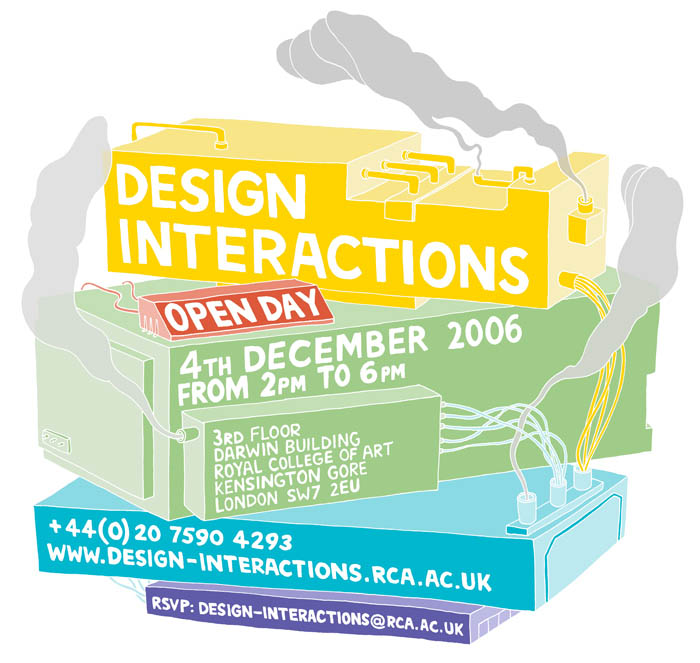
I'm in the process of (re)designing the MBA elective I'll be teaching in the third term of this academic year ("Trinity term" in Oxford speak). Like last year, this will include a three-week project working with MA design students from the Royal College of Art, London. To discuss this I met up with Tony Dunne, professor and head of the Design Interactions department, and tutor Nina Pope, with whom I used to lead a unit (or "platform", in design school speak) in the same department. (Anyone interested in taking that MA might want to attend their open day next week - see the poster on the side.) We'll also be working again with tutor Noam Toran and MA Design Products students. I'm grateful for some feedback from some of last year's MBA students who have helped me understand their goals in taking the elective.

In terms of the formalized bodies of knowledge taught within the MBA, Design Leadership is perhaps best thought of as a boundary-spanning way of thinking that connects with the business disciplines of strategy; operations management; marketing; and innovation studies; and necessarily must also relate to finance and accounting. Last year, students taking my elective also took some of the specialist Marketing, Culture and Society electives offered by Doug Holt and colleagues, Victor Seidel's elective in Entrepreneurship and Technology Ventures; and Victor and Marc Ventresca's Technology and Innovation Strategy elective, and Charlie Leadbeater's elective in Social Entrepreneurship.

Key to my elective are these ideas: the differences between design management and design leadership; understanding non-designers' impact on design in organizations - what is known as "silent design"; and knowledge and understanding of design practices, design methods and what is often called "design thinking". These ideas are underpinned by a pedagogical approach which involves project-based learning as well as more traditional lectures and seminars, and in particular the experience of learning by working directly with designers. It also explores the need for entrepeneurs and managers to tolerate ambiguity, develop visual literacy, and learn through practice about the power of prototyping and other visualizations.

The elective is, as the name suggests, chosen by students (from among 35 offered), and the class size is limited. But luckily all 225 MBAs get to encounter some of this material on the Operations Mangement core course.