Guy Julier (Leeds Met) and Liz Moor (Middlesex) have convened a research project called Counting Creativity, whose first workshop was held at the Design Council's offices in London last week, bringing together academics and practitioners. The project investigates the growth in practices of accounting, routine organization, systematization and measuring in design studios and companies.
In their introduction to the event, they wrote:
"In recent years, design and, by extension, branding, advertising and design in the built environment, have been increasingly subject to these effects, both internally in their working practices and externally in their evaluation. No doubt this reflects many wider trends in society, but it’s particularly interesting where creativity and systemization actually meet head-on in the design industry. Everyone in creative fields has a view on this. However, we are interested in finding out why this has come about, analyzing what are its effects and considering what can be done to improve design processes."
Hearing first hand from people working in commercial studios (such as an ad agency) or in public sector museums (such as the V&A) brought to life these questions. If designers now have to account for their time in six minute chunks (but actually create a week's worth of data on Monday mornings), how does this make us think about which bits of their work are "creative" and which are not?
In my presentation, I talked about projects in which I undertook unauthorized versions of such practices of evaluation and measurement, for example my book Audit and collaborative project Personal Political Indices (Pindices) with sociologist Andrew Barry. I used these to raise issues such as: being attentive to how these practices are embedded in networks of relations; how data is produced, not gathered; and how data production is tied up with data representation.
I argued that design companies do not have to take an uncritical approach to evaluation and simply reproduce established (and now challenged) practices and procedures drawn from management. Designers might even see the drive to account for their creativity as an opportunity to (re)design such artefacts, building into them the ambiguity and not-knowing which are essential parts of the design process.
Tuesday, January 23, 2007


Monday, January 15, 2007
New contexts for design
A few days ago I participated in the International Design Principles and Practices Conference, organized by Common Ground (Australia) and held at Imperial College London. In contrast to other academic juggernauts I've attended, this one was pleasingly small and intimate, with an international mix of people from different backgrounds including interior design, engineering, interaction design, design theory and quite a few people from business schools.
I particularly enjoyed two papers, both giving design a refreshing and welcome critical social science treatment: one by Guy Julier from Leeds Met and one by Monika Buscher from Lancaster University. Guy's paper drew on practice theory (such as Harvey Molotch's Where Stuff Comes From) to explore end user motivations enacted through their practices - a perspective which does not often appear in design research or education, as far as I know.
Monika described some work from a larger (100 person) interdisciplinary research project in palpable computing in which she is undertaking ethnographic field studies of how landscape architects work. Informed by Science and Technology Studies, Monika's work is drawing attention to how "the design is negotiated with all the human and non-human agencies" (my notes) in the way these architects go about their work.
Both of these contributions for me raise questions about the intentions of designers, the design process and how it should and can be undertaken and managed. Both provide ways to move away from the historical preoccupation with objects and to pay closer critical attention to the ways people engage with objects and the contexts in which they do so.
The keynote by Ken Friedman, whose teaching and research bridges design (at Denmark's Design School), management (at the Norwegian School of Management) and the arts (artist and founder of Fluxus), shared the fruits of his interdisciplinarity. His articulation of ten challenges for designers was also a statement of the challenges facing entrepreneurs and people in organizations whether in the non-profit, or for profit sectors, given contemporary questions such as climate change, AIDS and poverty.
I particularly enjoyed two papers, both giving design a refreshing and welcome critical social science treatment: one by Guy Julier from Leeds Met and one by Monika Buscher from Lancaster University. Guy's paper drew on practice theory (such as Harvey Molotch's Where Stuff Comes From) to explore end user motivations enacted through their practices - a perspective which does not often appear in design research or education, as far as I know.
Monika described some work from a larger (100 person) interdisciplinary research project in palpable computing in which she is undertaking ethnographic field studies of how landscape architects work. Informed by Science and Technology Studies, Monika's work is drawing attention to how "the design is negotiated with all the human and non-human agencies" (my notes) in the way these architects go about their work.
Both of these contributions for me raise questions about the intentions of designers, the design process and how it should and can be undertaken and managed. Both provide ways to move away from the historical preoccupation with objects and to pay closer critical attention to the ways people engage with objects and the contexts in which they do so.
The keynote by Ken Friedman, whose teaching and research bridges design (at Denmark's Design School), management (at the Norwegian School of Management) and the arts (artist and founder of Fluxus), shared the fruits of his interdisciplinarity. His articulation of ten challenges for designers was also a statement of the challenges facing entrepreneurs and people in organizations whether in the non-profit, or for profit sectors, given contemporary questions such as climate change, AIDS and poverty.
Monday, January 08, 2007
Reviewing design in 2006
The last few weeks have, as usual, seen the British newspapers I read conduct their reviews of the year and previews of the year ahead with lists and rankings, recommendations and tips. As usual, there were no informed discussions of design practices and outcomes. Indeed design was mostly invisible, although discussed in some papers within distinct categories such as fashion, architecture and consumer electronics/gadgets. Entangled with consumption, design artefacts are the only things you get to read about in these newspapers - as long as you can buy them and put them in your home, on your desk, or on your body. Within the arts pages, in contrast, film, books, visual art, theatre, dance, opera and music each have their critics and commentators discussing not just outcomes but also the contexts of production.
The problem is of course that everything has been through some kind of design process, so a review of design for 2006 might end up being a meta-list. But even if we limited ourselves to the kinds of things taught and researched at design schools and looked for a national discussion of these in the broadsheets, we still find the major UK media outlets keeping silent about design.
I wonder if - hope that - this might change over the next few years. The UK University and Colleges Admissions Service (Ucas) has just published its figures for acceptances onto undergraduate programmes. The BBC's report on this is worth a read: in second place for 2006 is "design studies" (below law in first place and above management studies at four). Part of the reason, the BBC reports, is a desire for degree-level studies that relate to vocations and professions. But perhaps it's also possible to read into this a desire on the part of these new undergraduates to develop their knowledge and understanding of how the world is designed and how they might into a reflective, informed discussion about their own designing practices. Or it could be that all the DIY makeover programmes on TV have given them visions of future success as future interior designers...
The problem is of course that everything has been through some kind of design process, so a review of design for 2006 might end up being a meta-list. But even if we limited ourselves to the kinds of things taught and researched at design schools and looked for a national discussion of these in the broadsheets, we still find the major UK media outlets keeping silent about design.
I wonder if - hope that - this might change over the next few years. The UK University and Colleges Admissions Service (Ucas) has just published its figures for acceptances onto undergraduate programmes. The BBC's report on this is worth a read: in second place for 2006 is "design studies" (below law in first place and above management studies at four). Part of the reason, the BBC reports, is a desire for degree-level studies that relate to vocations and professions. But perhaps it's also possible to read into this a desire on the part of these new undergraduates to develop their knowledge and understanding of how the world is designed and how they might into a reflective, informed discussion about their own designing practices. Or it could be that all the DIY makeover programmes on TV have given them visions of future success as future interior designers...
Wednesday, December 20, 2006
Designing services in science and technology-based enterprises: first event

On Monday and Tuesday, around 30 people from different contexts - all involved in researching, designing or operating services - gathered in Oxford for our first interdisciplinary project workshop in this one-year research project, funded by the AHRC and EPSRC' Designing for the 21st Century initiative. They included senior team members from science and technology-based enterprises, service design consultancies, and academics from different disciplines including strategy, innovation studies, operations management, science and technology studies, computer science and design. The project asks - and will try to answer - how members of these communities understand the designing of services in science and technology-based enterprises. It's therefore a project concerned with sense-making and sharing of understandings. With my colleagues Victor Seidel and James Tansey, I have designed the project to make use of both design research and social science research methods. In a way, the research itself is a process of designing. While we have a goal, intentions, constraints, and a process to get there, but we do know what exactly we are going to produce - what sense we will be able to make across our different domains of knowledge and practice.
In any interdisciplinary group, finding a way to communicate is a key challenge, especially in an area which has seen relatively little academic research (compared, for example, to studies of innovation in products). Our outputs include a document that will propose a vocabulary (glossary, terminology) and possible primer or guide for practitioners. But another - possibly more significant output - will be a group of people who will have been through a sense-making journey together with implications for future question-making, future research and future practice.
We've now set up a project blog so please look there for posts by project participants on both the research process and findings.
Friday, December 15, 2006
Pride, prejudice and design
Re-reading Pride and Prejudice(1813) I'm reminded of the origins of the English word design. In her book Design Management, Brigitte Borja de Mozota draws attention to its origins in the Latin designare: ‘to designate’ and ‘to draw’ and concludes "DESIGN = INTENTION + DRAWING" (Borja de Mozota, 2003, p3). In contemporary English usage, of course, we also still have the usage of the noun connected to plots, treachery or intrigue as in:
"He had designs on someone's property" (see the dictionary.com full listing).
But even being familiar with this I still found myself noticing Jane Austen's extensive usage of both noun and verb forms. Here, for example, is the protagonist Elizabeth's uncle discussing the intentions of Wickham towards her younger sister who has run off with the officer.
"..It appears to me so very unlikely, that any young man should form such a design against a girl, who is by no means unprotected or friendless, and who was actually staying in his colonel's family, that I am strongly inclinced to hope the best." (Odhams Press, London, no date, p267) And similarly Elizabeth's elder sister - heavily in denial - talking of her admirer Mr. Bingley, says she is "perfectly satisfied from what his manners now are, that he never had any design of engaging my affection." (p327)
This is consistent with contemporary (although uncommon) usage. But elsewhere Austen uses the verb form of design in a way that I would be surprised to hear today:
"Mrs. Bennet had designed to keep the two Netherfield gentlemen to supper; but their carriage was unluckily ordered before any of the others, and she had no opportunity of detaining them." (p326)
Reading this novel, in which designs and designing are so entangled with intrigue and seduction reminds me of the role of rhetoric in design. A design (sketch, model, prototype, or proposal) or a designer presents, proposes and seduces. Design activities plan and fashion possible outcomes but they do not always do this honestly. Designing and designs stimulate desire, and with desire comes treachery.
But pray excuse me. I will detain you no longer, dear Reader. I must go and order my carriage.
"He had designs on someone's property" (see the dictionary.com full listing).
But even being familiar with this I still found myself noticing Jane Austen's extensive usage of both noun and verb forms. Here, for example, is the protagonist Elizabeth's uncle discussing the intentions of Wickham towards her younger sister who has run off with the officer.
"..It appears to me so very unlikely, that any young man should form such a design against a girl, who is by no means unprotected or friendless, and who was actually staying in his colonel's family, that I am strongly inclinced to hope the best." (Odhams Press, London, no date, p267) And similarly Elizabeth's elder sister - heavily in denial - talking of her admirer Mr. Bingley, says she is "perfectly satisfied from what his manners now are, that he never had any design of engaging my affection." (p327)
This is consistent with contemporary (although uncommon) usage. But elsewhere Austen uses the verb form of design in a way that I would be surprised to hear today:
"Mrs. Bennet had designed to keep the two Netherfield gentlemen to supper; but their carriage was unluckily ordered before any of the others, and she had no opportunity of detaining them." (p326)
Reading this novel, in which designs and designing are so entangled with intrigue and seduction reminds me of the role of rhetoric in design. A design (sketch, model, prototype, or proposal) or a designer presents, proposes and seduces. Design activities plan and fashion possible outcomes but they do not always do this honestly. Designing and designs stimulate desire, and with desire comes treachery.
But pray excuse me. I will detain you no longer, dear Reader. I must go and order my carriage.
Friday, December 01, 2006
MBA Design Leadership elective 2006-7
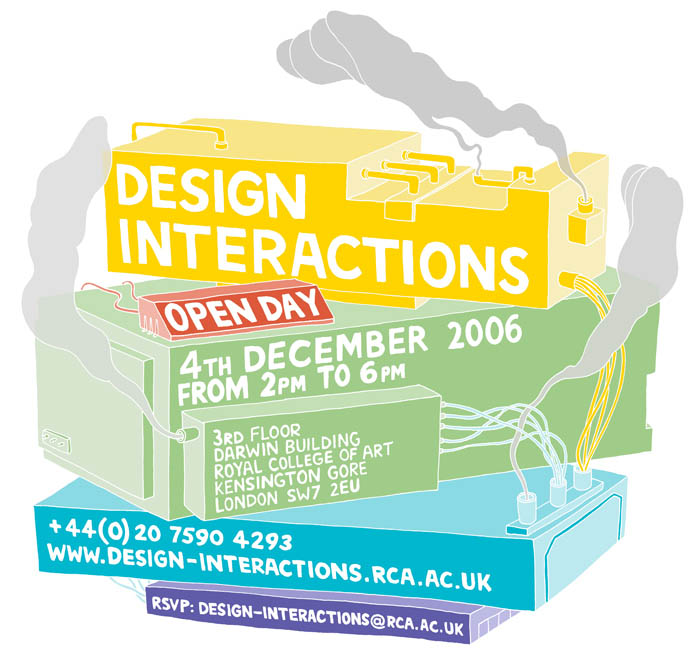
I'm in the process of (re)designing the MBA elective I'll be teaching in the third term of this academic year ("Trinity term" in Oxford speak). Like last year, this will include a three-week project working with MA design students from the Royal College of Art, London. To discuss this I met up with Tony Dunne, professor and head of the Design Interactions department, and tutor Nina Pope, with whom I used to lead a unit (or "platform", in design school speak) in the same department. (Anyone interested in taking that MA might want to attend their open day next week - see the poster on the side.) We'll also be working again with tutor Noam Toran and MA Design Products students. I'm grateful for some feedback from some of last year's MBA students who have helped me understand their goals in taking the elective.
In terms of the formalized bodies of knowledge taught within the MBA, Design Leadership is perhaps best thought of as a boundary-spanning way of thinking that connects with the business disciplines of strategy; operations management; marketing; and innovation studies; and necessarily must also relate to finance and accounting. Last year, students taking my elective also took some of the specialist Marketing, Culture and Society electives offered by Doug Holt and colleagues, Victor Seidel's elective in Entrepreneurship and Technology Ventures; and Victor and Marc Ventresca's Technology and Innovation Strategy elective, and Charlie Leadbeater's elective in Social Entrepreneurship.
Key to my elective are these ideas: the differences between design management and design leadership; understanding non-designers' impact on design in organizations - what is known as "silent design"; and knowledge and understanding of design practices, design methods and what is often called "design thinking". These ideas are underpinned by a pedagogical approach which involves project-based learning as well as more traditional lectures and seminars, and in particular the experience of learning by working directly with designers. It also explores the need for entrepeneurs and managers to tolerate ambiguity, develop visual literacy, and learn through practice about the power of prototyping and other visualizations.
The elective is, as the name suggests, chosen by students (from among 35 offered), and the class size is limited. But luckily all 225 MBAs get to encounter some of this material on the Operations Mangement core course.
Monday, November 20, 2006
Mass collaboration: Silicon Valley comes to Oxford
The school again hosted Silicon Valley Comes to Oxford, an intense day of panels and discussions led by (successful, and often serial) internet entepreneurs and those involved enabling infrastructure and services such as venture capital and law.
I benefitted from hearing in-depth presentations by two speakers: first, Matt Cohler, VP of strategy and business operations at Facebook, a social networking site, and Julie Hanna Farris, co-founder and director of Scalix, an Open Source based enterprise email and calendaring application provider. Matt's talk included two key ideas where design disciplines and practices have something to offer entrepreneurs: the first being the requirement to think how to "create value for end users" rather than building a business model, rather than the other way round. The second idea he emphasized was the importance of iterating the product, and learning from user behaviour and feedback. Take a flexible and iterative approach, he advised, in contrast to what's taught in business school; very small details can make a huge difference and you have to keep iterating to find out what the details that matter are.
In her talk Julie Hanna Farris discussed the principles of Open Source software (underpinning its many variants) and how they are disrupting conventional business models. In particular she emphasized community, transparency, authenticity, word of mouth, informality, and motivation. Each of these presents problems for business people and investors used to conventional businesses. Like Cohler, Farris stressed the importance of trying things out and learning: "Fail early and often" - a phrase that design company IDEO also invokes. Her seasoned advice to entrepreneurs included making customers part of the process of building a product - and of knowing customers not just markets. I don't think I heard the word "design" in either of their talks but what design theorists and practitioners would recognise as design principles - iterative processes, human-centred frameworks, co-design with end users - were already there.
The evening panel threw up another set of insights from a panel including Facebook's Matt Cohler; Allen Morgan of venture capitalists Mayfield; Reid Hoffman, CEO and founder of Linked-In; and Chris Sacca, head of special initiatives at Google, chaired by FT journalist Jonathan Guthrie. The post-Web 2.0 future according to these speakers was seen to be: filtered by social context, more personalised, more complementary to your other ongoing activities, and more responsive to your identity. I was struck by a comment from (I think) all four speakers at different points, that they would most likely not invest in an enterprise that didn't come to them introduced by someone they knew. At first glance, this is business as usual: networks of the powerful investing in those to whom they are already connected in some way. But with the ability to design, develop, launch, run and continue to iterate digital networked products with rapid feedback from end users, internet entpreneurs can - if they succeed in instantiating a community around what they offer - perhaps join those networks. (George - if you read this - you already have done 80% of the work with Chatsum).
A question I asked about which practices, and which academic disciplines, had most insights to offer entrepreneurs and investors about end users and their behaviours generated the following suggestions: psychology, social sciences, game theory, and the need to be able to analyse and understand the vast amounts of data being generated (Chris Sacca: "We worship data."). But not, alas, design. There remains a significant gap between what designers are perceived to be able to do - or are educated to do - and what designers are asked to do - and what they can do. I wonder if Bill Moggridge's forthcoming book Designing Interactions (MIT Press) will be on Silicon Valley's reading list.
I benefitted from hearing in-depth presentations by two speakers: first, Matt Cohler, VP of strategy and business operations at Facebook, a social networking site, and Julie Hanna Farris, co-founder and director of Scalix, an Open Source based enterprise email and calendaring application provider. Matt's talk included two key ideas where design disciplines and practices have something to offer entrepreneurs: the first being the requirement to think how to "create value for end users" rather than building a business model, rather than the other way round. The second idea he emphasized was the importance of iterating the product, and learning from user behaviour and feedback. Take a flexible and iterative approach, he advised, in contrast to what's taught in business school; very small details can make a huge difference and you have to keep iterating to find out what the details that matter are.
In her talk Julie Hanna Farris discussed the principles of Open Source software (underpinning its many variants) and how they are disrupting conventional business models. In particular she emphasized community, transparency, authenticity, word of mouth, informality, and motivation. Each of these presents problems for business people and investors used to conventional businesses. Like Cohler, Farris stressed the importance of trying things out and learning: "Fail early and often" - a phrase that design company IDEO also invokes. Her seasoned advice to entrepreneurs included making customers part of the process of building a product - and of knowing customers not just markets. I don't think I heard the word "design" in either of their talks but what design theorists and practitioners would recognise as design principles - iterative processes, human-centred frameworks, co-design with end users - were already there.
The evening panel threw up another set of insights from a panel including Facebook's Matt Cohler; Allen Morgan of venture capitalists Mayfield; Reid Hoffman, CEO and founder of Linked-In; and Chris Sacca, head of special initiatives at Google, chaired by FT journalist Jonathan Guthrie. The post-Web 2.0 future according to these speakers was seen to be: filtered by social context, more personalised, more complementary to your other ongoing activities, and more responsive to your identity. I was struck by a comment from (I think) all four speakers at different points, that they would most likely not invest in an enterprise that didn't come to them introduced by someone they knew. At first glance, this is business as usual: networks of the powerful investing in those to whom they are already connected in some way. But with the ability to design, develop, launch, run and continue to iterate digital networked products with rapid feedback from end users, internet entpreneurs can - if they succeed in instantiating a community around what they offer - perhaps join those networks. (George - if you read this - you already have done 80% of the work with Chatsum).
A question I asked about which practices, and which academic disciplines, had most insights to offer entrepreneurs and investors about end users and their behaviours generated the following suggestions: psychology, social sciences, game theory, and the need to be able to analyse and understand the vast amounts of data being generated (Chris Sacca: "We worship data."). But not, alas, design. There remains a significant gap between what designers are perceived to be able to do - or are educated to do - and what designers are asked to do - and what they can do. I wonder if Bill Moggridge's forthcoming book Designing Interactions (MIT Press) will be on Silicon Valley's reading list.
Friday, November 17, 2006
Dinner chez Arne Jacobsen


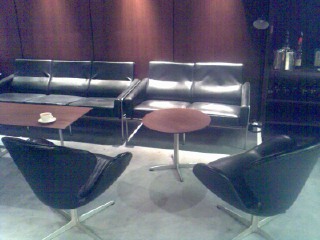
After staying the night there last week, this week I had dinner at St Catherine's college - where form meets function (according to a college poster spotted on the way in) - the guest of Andrew Barry, fellow of the college and member of the Oxford Centre for the Environment. Given Oxford's history and much of the existing architecture, it was a radical decision to appoint an architect such as Arne Jacobsen for a new Oxford college. He paid a great deal of attention in the design to the forms both of the buildings and the gardens, and to details of fittings like door handles and the furniture in the senior common room (SCR) and the cutlery at high table (shown here). My hosts indulged me and let me take some pictures and even went as far as asking the steward to show me the two soup spoons - one for the left handed and one for the right handed.
Thursday, November 09, 2006
Chez Arne Jacobsen



One of the things about working in Oxford and living in London is that I need to stay over in Oxford every week. Sometimes I stay with friends, but often in the fellows' guest rooms of the colleges. Last night I stayed again at St Catherine's College, designed by Arne Jacobsen and now, forty years or so on, more than slightly worn. But that might not trouble him. As I lay on my patterned duvet in the room, I imagined that Jacobsen would be disappointed how the calm simplicity of his design has been encroached upon by Bed & Breakfast chic, as the images I took show. On the simple desk, the tea making service. On the chest of drawers, the telly. A blanket covering a chair. A fan, for hot days. An electric radiator, for cold ones.
Monday, November 06, 2006
Wonderground: Design Research Society conference, Lisbon

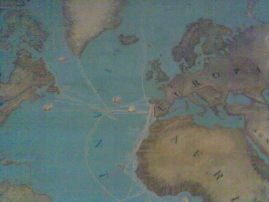
Last week I joined over 250 people attending the Design Research Society's Wonderground conference in Lisbon bringing together researchers working in diverse design disciplines including graphic and product design, architecture, interaction design and the odd engineer. The plenaries were held in the grand Society of Geography built in the mid-19th century. On display were massive statues of the major Portuguese mariners who travelled the world in the 15th century (see Vasco da Gama, to the left), and a large map showing some of their significant journeys, the trails that are so linked to colonization and globalization.
Conferences such as these can be frustrating and stimulating since they involve people at different stages of their professional careers with different levels of knowledge and understanding about their own practices and research and their wider context. So in each presentation you have to focus really hard on both what the presenter is saying and why they are saying it now; I needed a geography, and a history (which we got in a presentation from Nigel Cross), and a sociology and an economy and a politics of design research. What I found valuable about attending was access to a snapshot of design research activity within (mostly) academic contexts to help me situate my own research, within a social science institution. I also liked the vinho verde and the pasteis de nata.
Friday, October 27, 2006
"Go work for a credit reference agency"
I enjoyed reading i-Gitators in Action: Can Service Innovation (Design :-) ) Save the World?, a three-way conversation between GK van Patter (NextD Institute), Chris Downs (live|work, see links on right hand side of page) and Gill Wildman (Plot) discussing among other things the emergence of service design, and the state of design education and promotion in the UK (all references to "design" here meaning design based in liberal arts traditions rather than engineering design or computer science).
As I have remaked in other posts, there is a considerable disconnect between practitioners and academics inventing new domains of knowledge connected with services. Patching between these nodes is not as simple as citing a few references in each others' reading lists or even inviting speakers to join conferences, but rather a more disturbing encounter with the Other: with different ways of thinking about the world, and about what kinds of knowledge can be produced. I think these questions are more fundamental than trying to define which leads: design, or innovation? I regret I am not educated in philosophy but its underlying questions and theories are important and useful. For example, the word "abductive" now pops up regularly in conversations about design (and sometimes in management too: see Roger Martin's contributions to the Rotman business school magazine), although you won't find it in many texts on research methods which (in a gross simplification) focus on comparing inductive and deductive methods. As someone from a design background now situating my practices within a management school framed by social sciences, I am hoping in a modest way to make some useful knots (in the Haraway sense) but cannot do this without engaging with these Others.
Chris' advice to new design graduates was welcome. "Embrace and enjoy the complexity. Get out of college and get a job. Don’t hang around in your school’s new ‘future design blah innovation blah lab.’ Don’t prostitute your services for free to get a toe in the door at IDEO, Humantific, Plot or even live|work. Go and work for a hospital, the government or a credit reference agency. " This advice I think acknowledges the "silent design" (Gorb and Dumas' term, see citation in earlier post) that goes on, all the time, all over the world, where people who are not educated as designers, and do not think of themselves as designers, are busy designing things and re-designing them through usage, like those 70% of services in the global economy. On the one hand we have "silent design" and on the other "noisy design" (my term with this usage, as far as I know): the bigging-it-up of capital-d Designers whose claims about the importance/efficacy/value of their practices are tied up with authorship, ownership, and object-based cultures and economies. In my classes with MBA students this is a key part of my message: Be aware of your own role as designers (managers, entrepreneurs). Know why, how and when to work with design processes and practices. Not silent design, or noisy Design, but reflective, reflexive designing practices that acknowledge entanglements and tolerate difference, ambiguity and incompleteness.
As I have remaked in other posts, there is a considerable disconnect between practitioners and academics inventing new domains of knowledge connected with services. Patching between these nodes is not as simple as citing a few references in each others' reading lists or even inviting speakers to join conferences, but rather a more disturbing encounter with the Other: with different ways of thinking about the world, and about what kinds of knowledge can be produced. I think these questions are more fundamental than trying to define which leads: design, or innovation? I regret I am not educated in philosophy but its underlying questions and theories are important and useful. For example, the word "abductive" now pops up regularly in conversations about design (and sometimes in management too: see Roger Martin's contributions to the Rotman business school magazine), although you won't find it in many texts on research methods which (in a gross simplification) focus on comparing inductive and deductive methods. As someone from a design background now situating my practices within a management school framed by social sciences, I am hoping in a modest way to make some useful knots (in the Haraway sense) but cannot do this without engaging with these Others.
Chris' advice to new design graduates was welcome. "Embrace and enjoy the complexity. Get out of college and get a job. Don’t hang around in your school’s new ‘future design blah innovation blah lab.’ Don’t prostitute your services for free to get a toe in the door at IDEO, Humantific, Plot or even live|work. Go and work for a hospital, the government or a credit reference agency. " This advice I think acknowledges the "silent design" (Gorb and Dumas' term, see citation in earlier post) that goes on, all the time, all over the world, where people who are not educated as designers, and do not think of themselves as designers, are busy designing things and re-designing them through usage, like those 70% of services in the global economy. On the one hand we have "silent design" and on the other "noisy design" (my term with this usage, as far as I know): the bigging-it-up of capital-d Designers whose claims about the importance/efficacy/value of their practices are tied up with authorship, ownership, and object-based cultures and economies. In my classes with MBA students this is a key part of my message: Be aware of your own role as designers (managers, entrepreneurs). Know why, how and when to work with design processes and practices. Not silent design, or noisy Design, but reflective, reflexive designing practices that acknowledge entanglements and tolerate difference, ambiguity and incompleteness.
Wednesday, October 25, 2006
Designing services in science and technology-based enterprises
Funding sucess! With my colleagues James Tansey (James Martin Institute, science and technology studies), Victor Seidel (innovation studies) and Fiona Reid (director, Oxford Science Enterprise Centre), I put together a proposal which we submitted to the Arts and Humanities Research Council and Engineering and Physical Sciences Research Council's Designing for the 21st Century initiative.
Designing services in science and technology-based enterprises involves a group of academics (mostly within social sciences), designers, and technology and science entrepreneurs from a range of disciplines working together to explore how services as designed in science and technology-based enterprises. We have recently heard that the project has been awarded funding and will spend the next 12 months undertaking the project. It involves two kinds of engagement:
- four short projects in which service designers help early stage technology and science entrepreneurs based in Oxford design their services (likely to be B2B) (one design company with each enterprise), taking place February-May 2007
- five events held over a year at SBS, which reflect on these encounters and attempt to develop a cross-disciplinary vocabulary for service design in science and technology enterprises.
Design company participants include: live|work, IDEO, and Radarstation (and one more to be confirmed). Science and technology enterprise participants are currently being approached; they are likely to include companies offering services in biotechnology and information technologies.
Confirmed academic participants include Tony Dunne (Royal College of Art, interaction design), Bill Hollins (Westminster Business School, service operations), Leonieke Zomerdijk (London Business School, service operations), Jennifer Whyte (Tanaka Business School, innovation studies). Within SBS, academic participants include Mari Sako (strategy), Steve New (operations) and Dan Neyland (James Martin Institute). Within Oxford University, participants include Andrew Barry (Oxford Centre for the Environment) and Marina Jirotka (ComLab).
The project's broad research questions ask how participants' ideas about the designing of services change during the project once they are exposed to the approaches and practices within other disciplines and contexts. Outputs will include a publication of the shared vocabulary developed in the project, as well as more traditional academic outputs such as papers for journals and conferences.
Designing services in science and technology-based enterprises involves a group of academics (mostly within social sciences), designers, and technology and science entrepreneurs from a range of disciplines working together to explore how services as designed in science and technology-based enterprises. We have recently heard that the project has been awarded funding and will spend the next 12 months undertaking the project. It involves two kinds of engagement:
- four short projects in which service designers help early stage technology and science entrepreneurs based in Oxford design their services (likely to be B2B) (one design company with each enterprise), taking place February-May 2007
- five events held over a year at SBS, which reflect on these encounters and attempt to develop a cross-disciplinary vocabulary for service design in science and technology enterprises.
Design company participants include: live|work, IDEO, and Radarstation (and one more to be confirmed). Science and technology enterprise participants are currently being approached; they are likely to include companies offering services in biotechnology and information technologies.
Confirmed academic participants include Tony Dunne (Royal College of Art, interaction design), Bill Hollins (Westminster Business School, service operations), Leonieke Zomerdijk (London Business School, service operations), Jennifer Whyte (Tanaka Business School, innovation studies). Within SBS, academic participants include Mari Sako (strategy), Steve New (operations) and Dan Neyland (James Martin Institute). Within Oxford University, participants include Andrew Barry (Oxford Centre for the Environment) and Marina Jirotka (ComLab).
The project's broad research questions ask how participants' ideas about the designing of services change during the project once they are exposed to the approaches and practices within other disciplines and contexts. Outputs will include a publication of the shared vocabulary developed in the project, as well as more traditional academic outputs such as papers for journals and conferences.
Tuesday, October 24, 2006
If there are Services Sciences, where are the services arts?
Last Thursday I participated in a workshop on Services Science at London Business School, hosted by Chris Voss (LBS) with Aleda Roth (Clemson University), both working within the fields of operations management. The aim of the event was to reflect on a development led by people working at IBM, who since 2004 have been trying to articulate a need and scope for a new multidisciplinary academic discipline of Services Sciences, Management and Engineering. Voss and Roth drew on papers published by the IBM researchers. Afternoon speakers were Richard Taylor, from Hewlett Packard, and Paul Tasker, from Cambridge University's Institute for Manufacturing. Many others are also working to define an area, such as Hewlett Packard which hosted a recent event at its Centre for Systems and Services Sciences.
Two things struck me: the first concerning who is currently contributing to, and leading, conversations about the designing of services; and second, the missing art in Services Sciences.
Based on my reading of the attendees list, the majority of participants were academic researchers working with a management discipline, others with a background in engineering or computer science, and some policy makers and advisers: this was an interdisciplinary and practitioner-academic event. But there were, for example, no (obvious) participants from design backgrounds (meaning design rooted in arts traditions) other than myself - a hybrid, being a designer in a business school - demonstrating the gulf between these communities. Similarly, an International Service Design Conference held in Gateshead earlier this year included speakers almost exclusively from organizations working within the field of design grounded in arts-based education and practices, rather than systems engineering or IT (although IDEO does have an engineering design background); there were no operations managers, no innovation studies researchers, no strategy researchers, no social scientists. I was unable to attend that event but suspect the attendees came from similar backgrounds. I think this gap matters for these reasons: because it must impact on how practitioners and researchers learn from other modes of engaging with the world, knowing the world and practicing on the world; and to avoid re-inventing the wheel.
This disconnection perhaps contributes to the second thing I noticed. Aleda Roth's presentation of IBM's work included a diagram produced by one of the IBM researchers (Jim Spohrer, director of Services Research at IBM Almaden Research Center) which listed which academic disciplines Services Science drew on. That list included management, engineering and social sciences but as far as I could tell, nothing that is part of the humanities. As Roth pointed out in her analysis of the IBM work, "What's missing is the art, the soul, the artistic and creative disciplines." (This lead to a - thankfully brief - discussion by offended engineers who do not like to be thought of as not being creative.)
While I am wary of ascribing to designers and artists the term 'creative' to characterise their distinctive contributions, I am left wondering what it means if an emerging, self-described science (led by a technology company) ignores the contributions to culture, society, technology and economies from work in the humanities, whether that be literature or visual art or anything else in which poetics matter and aesthetics matter. IBM, in its quest to identify the tools needed by future services scientists, might benefit from wondering where the services arts are in its conception of services science.
Two things struck me: the first concerning who is currently contributing to, and leading, conversations about the designing of services; and second, the missing art in Services Sciences.
Based on my reading of the attendees list, the majority of participants were academic researchers working with a management discipline, others with a background in engineering or computer science, and some policy makers and advisers: this was an interdisciplinary and practitioner-academic event. But there were, for example, no (obvious) participants from design backgrounds (meaning design rooted in arts traditions) other than myself - a hybrid, being a designer in a business school - demonstrating the gulf between these communities. Similarly, an International Service Design Conference held in Gateshead earlier this year included speakers almost exclusively from organizations working within the field of design grounded in arts-based education and practices, rather than systems engineering or IT (although IDEO does have an engineering design background); there were no operations managers, no innovation studies researchers, no strategy researchers, no social scientists. I was unable to attend that event but suspect the attendees came from similar backgrounds. I think this gap matters for these reasons: because it must impact on how practitioners and researchers learn from other modes of engaging with the world, knowing the world and practicing on the world; and to avoid re-inventing the wheel.
This disconnection perhaps contributes to the second thing I noticed. Aleda Roth's presentation of IBM's work included a diagram produced by one of the IBM researchers (Jim Spohrer, director of Services Research at IBM Almaden Research Center) which listed which academic disciplines Services Science drew on. That list included management, engineering and social sciences but as far as I could tell, nothing that is part of the humanities. As Roth pointed out in her analysis of the IBM work, "What's missing is the art, the soul, the artistic and creative disciplines." (This lead to a - thankfully brief - discussion by offended engineers who do not like to be thought of as not being creative.)
While I am wary of ascribing to designers and artists the term 'creative' to characterise their distinctive contributions, I am left wondering what it means if an emerging, self-described science (led by a technology company) ignores the contributions to culture, society, technology and economies from work in the humanities, whether that be literature or visual art or anything else in which poetics matter and aesthetics matter. IBM, in its quest to identify the tools needed by future services scientists, might benefit from wondering where the services arts are in its conception of services science.
Tuesday, October 17, 2006
Donna Haraway's indigestion
"He enriches my ignorance." This quote, from New Zealand writer Ian Wedde talking about his dog, opens one of the chapters of the next book by writer and academic Donna Haraway; this phrase, and the ways of knowing it invokes, struck me as a way to think about designing practices. Haraway visited the James Martin Institute at Saïd Business School last week and I was one of the people who joined her seminar after reading two draft chapters from the new book. The book, as I understand it, tries to rethink human/non-human relations, by presenting what Haraway refered to as "knots" such as her own practice of agility training with her dog/partner Cayenne (already rehearsed in previous work); crittercams (cameras attached to animals for entertainment or research); feral cats: and other examples where humans are entangled with other creatures and with technologies which enact difficult, messy problems.
Haraway talked in terms of "discomfort" being her way in; her work as an attempt to "make worlds by grappling with the ordinary" , enriching some of her reflections on STS (Science and Technology Studies), an approach to doing sociology whose other leading scholars include my colleague Steve Woolgar (who hosted Haraway), Bruno Latour and others. Her comments were an echo of attempts by design and art theorists to characterise the nature of (some?) practitioner work where the kinds of tensions, or knots, that Haraway describes are made manifest in the work. When Haraway said "I'm trying to remain uncomfortable for a lifetime" in relation to her teaching and research practices as a feminist scholar, I was reminded of the messy ambiguity within creative processes: the not-knowing which designers and artists seem well able to tolerate before a project is resolved in some way. Of course this same indeterminacy or necessary ambiguity has been described elsewhere: Buchanan's essay "Wicked Problems in Design Thinking", for example, (in the design studies tradition), or Jonathan Rosenhead's paper "Into the Swamp" (in operations research). I'm currently finding Lacan's model of the Real, Symbolic and the Imaginary a useful way to think about this, where the Real is that which cannot be symbolised. I understood Haraway's use of the term "indigestion" in a similar way. I am wondering if (some) design and art practices are a (the?) way to work through the ignorance, the indigestion, or the Real.
Haraway talked in terms of "discomfort" being her way in; her work as an attempt to "make worlds by grappling with the ordinary" , enriching some of her reflections on STS (Science and Technology Studies), an approach to doing sociology whose other leading scholars include my colleague Steve Woolgar (who hosted Haraway), Bruno Latour and others. Her comments were an echo of attempts by design and art theorists to characterise the nature of (some?) practitioner work where the kinds of tensions, or knots, that Haraway describes are made manifest in the work. When Haraway said "I'm trying to remain uncomfortable for a lifetime" in relation to her teaching and research practices as a feminist scholar, I was reminded of the messy ambiguity within creative processes: the not-knowing which designers and artists seem well able to tolerate before a project is resolved in some way. Of course this same indeterminacy or necessary ambiguity has been described elsewhere: Buchanan's essay "Wicked Problems in Design Thinking", for example, (in the design studies tradition), or Jonathan Rosenhead's paper "Into the Swamp" (in operations research). I'm currently finding Lacan's model of the Real, Symbolic and the Imaginary a useful way to think about this, where the Real is that which cannot be symbolised. I understood Haraway's use of the term "indigestion" in a similar way. I am wondering if (some) design and art practices are a (the?) way to work through the ignorance, the indigestion, or the Real.
Tuesday, October 10, 2006
Business Week on design & business education links
Business Week has put together a list of top "D-Schools" which includes some "B-Schools" where there are direct engagements with design such as interdisciplinary projects involving both MBA and MA students. The list includes business schools from North America (such as Rotman School of Management, Toronto, and the Sloan School of Management at MIT) and Europe (only two: Saïd Business School and the new Zollverein School of Management and Design, which as its name suggests is a hybrid). The design schools listed are in Europe, North America, China, South Korea and India (such as Carnegie Mellon University's School of Design, the Royal College of Art, and Rhode Island School of Design). The accompanying article argues that companies are turning to design schools in their hunt for innovation leaders.
Wednesday, October 04, 2006
Experimental methodologies in art and design research
What are the effects of methodologies created by art and design researchers? Do they have the potential to challenge, and contribute to, research in other disciplines? Yesterday I was part of a one-day seminar on experimental methodologies at Wimbledon School of Art organised by, and for, PhD students in art and design to examine ways of thinking about, and doing, practice-based research, funded by the Arts and Humanities Research Council. The other speakers were Paul Halliday, urban photographer and sociologist from Goldsmiths, and Malcolm Quinn, reader in critical practice at Wimbledon. Paul Halliday drew our attention to the Surrealists (and others) whose use of the playful and chance in their practice is, he argued, an important contribution to sociology. Malcolm Quinn suggested there was an opportunity for the humanities to learn from artists: from how they approach context, and from the methods they invent, especially the necessity of fabrication. I talked about some of my projects (mostly art commissions) in which I use/disrupt methods of data gathering and presentation common within social sciences. Listening to the PhD students, whether working with paint, lens-based media, performance or drawing, I was reminded of the practices and approaches that constitute art and design education (at least in the UK) but which are not so evident in my current academic context, a school of management in an ancient university. I wonder to what extent playful fabrication is possible within the social sciences - what value it might have here?
Thursday, September 28, 2006
Design and complexity
Can designers learn from the emerging field of complexity science? I joined a workshop held at Saïd Business School which was one of the satellite events at the European Conference on Complex Systems (ECCS '06). The workshop was part of a wider series, organized as a cluster called Embracing Complexity in Art and Design funded through the first round of the cross-disciplinary Designing for the 21st Century initiative. Of particular value I found the presentation by Lauri Koskela of Salford University. He talked about the differences between ancient Greek terms such as analysis and synthesis and their current meanings, and the confusing attempts of competing contemporary design disciplines and "design science" to articulate theories about design. The ideas explored in Aristotle and Pappus, for example, constitute a proto-theory of design, he argued. Alec Robertson from De Montfort University described the More is More symposium held at the end of 2005 which brought together a range of perspectives. In design, he pointed out, it is considered a truism that 'less is more' but George Rzevski's workshop (at a previous event organised by the cluster) 'Complexity is Beautiful' was the starting point of an idea that challenges this: more is more. Jeff Johnson (Open University) and Eve Mitleton-Kelly (LSE) described interdisciplinary projects they are setting up that bring together social scientists and scientists working with complexity, with design and art practitioners. Like design, complexity is far from being a single discipline but it seems likely that cross-disciplinary discussions may lead to a valuable exchange. My questions would be: how do design practices respond to complex (or complicated) problems? To what extent do traditional or modern methods and skills cope with the challenges of designing complex products, services and environments?
Tuesday, September 26, 2006
Re-designing public services: a new public discourse
The emerging discipline of service design is becoming strikingly visible on the national agenda ... and is increasingly articulated by designers educated within art & design traditions rather than management or service delivery operations. Last week I attended a public event hosted by RED, a unit of the UK Design Council where three members of their interdisciplinary team of six presented what they do, and how and why they do it. The talk was part of a drop-in open day with a mini exhibition in the room next door. RED is led by Hilary Cottam (who won the Design Museum's Designer of the Year award last year). Its associates include the former head of IDEO's London office, Colin Burns, as well as Charlie Leadbeater, who also teaches social entrepreneurship at Said Business School.
RED is making an argument about the role of design in public services. Its focus is on helping create "a new generation of public services, designed around individuals" that are co-created with them, and that are preventative. Some of these ideas were made public in Feburary when RED published its paper on Transformation Design. Meanwhile over the summer, the influential UK think tank Demos published its paper on similar themes, entitled The Journey to the Interface co-written by Joe Heapy of service designer consultancy Engine, which makes an argument about how public service design can "connect users with reform". It seems as if a vocabulary and set of practices loosely assembled in fields such as experience design and human computer interaction design, enacted in both informal, commercial and academic domains, may now be taken up in public service contexts.
At the RED event, members of the team described their processes and methods and what they want to achieve. Jenny (no surname given) talked about RED's ambition to design for behaviour change: "As designers what we are doing is less about shaping form than shaping behaviour," she said. She went on to acknowledge that this sounded "a bit sinister" but then argued "But actually it's been used for a long time in the private sector." So these practices have the potential to (re)design not just the services, but the service users too. But the outcomes of public service designs are complex. RED sees value in making use of design methods used in Marks & Spencer, for example, to make the consuming experience "compelling and desirable" and applying them to public service contexts. In the M&S context, the use of these methods may well have a clear, measurable business objective: increasing sales, for example - and even here design practitioners may well struggle with framing the design problem, communicating with the client, and measuring the value of the design process and artefacts. How much harder it is to define and agree goals for public services or public goods. To what extent can design-led techniques make the UK more democratic? More healthy? More intelligent?
(all my transcriptions)
RED is making an argument about the role of design in public services. Its focus is on helping create "a new generation of public services, designed around individuals" that are co-created with them, and that are preventative. Some of these ideas were made public in Feburary when RED published its paper on Transformation Design. Meanwhile over the summer, the influential UK think tank Demos published its paper on similar themes, entitled The Journey to the Interface co-written by Joe Heapy of service designer consultancy Engine, which makes an argument about how public service design can "connect users with reform". It seems as if a vocabulary and set of practices loosely assembled in fields such as experience design and human computer interaction design, enacted in both informal, commercial and academic domains, may now be taken up in public service contexts.
At the RED event, members of the team described their processes and methods and what they want to achieve. Jenny (no surname given) talked about RED's ambition to design for behaviour change: "As designers what we are doing is less about shaping form than shaping behaviour," she said. She went on to acknowledge that this sounded "a bit sinister" but then argued "But actually it's been used for a long time in the private sector." So these practices have the potential to (re)design not just the services, but the service users too. But the outcomes of public service designs are complex. RED sees value in making use of design methods used in Marks & Spencer, for example, to make the consuming experience "compelling and desirable" and applying them to public service contexts. In the M&S context, the use of these methods may well have a clear, measurable business objective: increasing sales, for example - and even here design practitioners may well struggle with framing the design problem, communicating with the client, and measuring the value of the design process and artefacts. How much harder it is to define and agree goals for public services or public goods. To what extent can design-led techniques make the UK more democratic? More healthy? More intelligent?
(all my transcriptions)
Thursday, September 14, 2006
Process design paper at EUROMA conference
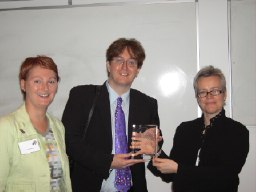
With my colleague Steve New, I presented a paper at the EUROMA (European Operations Management) conference held in June in Strathclyde. With the title "On the Anonymity and Invisibility of Process Design"we argued that within the field of Operations Management (OM), the task of process design has suffered neglect in the development of Operations Management. Although there is extensive literature on product design and to a lesser extent the design of services, the designing of processes is neglected. We examined how process design remains an essentially invisible and anonymous activity and then presented a three-point manifesto for change. First, we argued that, rather than imagining a target audience of generic Operations Managers, the field of OM should focus on the education and research needs of a newly-founded profession of Process Designers. Secondly we argued that OM needs to understand how to design, not just follow, design processes, and the difference between user involvement and ‘implementation’. Thirdly we argued that great Process Designers should be famous, like architects or product designers.
To illustrate our ideas we brought along some imagined artefacts from this world in which Process Design is a visible and recognised discipline (will be uploaded soon). These included a private view invitation to the opening of a fictional call centre; a screen grab from the Saïd Business School's website with details of a fictional MA/MBA in Process Design, taught jointly with the Royal College of Art; front covers of imaginary magazines for professional process designers; fictional TV listings showing reality TV and documentary programmes engaging with Process Design issues; and finally, a fictional award for Process Designer of the Year - the Voss Award (named - with kind permission - after Professor Chris Voss of London Business School for his years of involvement in OM and research into experience and service design). During the presentation we asked the audience to nominate potential winners for the award and we presented, on this occasion, the Voss Award 2006 to the nominators.
Links between design education and business education
This week I was supposed to be part of a group on a fact finding missing to San Francisco, Chicago and Boston, initiated by the UK Design Council and the Higher Education Funding Council for England. Unfortunately owing to recent illness I was unable to join the trip but my Said Business School colleague Marc Ventresca, who teaches and researches in strategy and innovation, was able to go. The aim is to examine models in US education in which design and management teaching and research are integrated in different ways, as part of the process of reflecting on the findings of the UK's Cox Review on Creativity in Business, published late last year. The arranged visits include the Stanford d-school, IDEO, Apple, Chicago's Institute of Design, and on the East Coast, MIT. A report about the trip will be made public by the Design Council.
The questions I hoped to consider on the trip included: How is 'design' enacted in different teaching and research institutions? What ways of working across disciplines are used? How current is the term 'design thinking'? What emphasis is there on service design and interaction design? To what extent do these institutions and organizations make claims about leading by design, and design as strategy?
The questions I hoped to consider on the trip included: How is 'design' enacted in different teaching and research institutions? What ways of working across disciplines are used? How current is the term 'design thinking'? What emphasis is there on service design and interaction design? To what extent do these institutions and organizations make claims about leading by design, and design as strategy?
Subscribe to:
Posts (Atom)


