I was one of approximately 30 participants at an event organized by my colleague Mari Sako, including academics from business schools, policymakers, and research scientists and practitioners from IT services companies such as IBM, HP and Tata Consulting Services. The event sought to stimulate and structure diverse thinking about services, which constitute over 70% of some economies, into a set of questions for research and teaching. My interest was exploring to what extent the emerging discipline of service design (inheriting and extending design methods and practices grounded in art and design education, as distinct from IT or engineering) has something to contribute to service innovation.
My presentation in one of the afternoon breakouts started with a provocative question: ‘You wouldn’t design a new product without a product designer. So why do organizations design new services without involving service designers?’ The question itself is of course problematic since it’s not clear that product designers are always involved in new product development, and if they are involved, what form their involvement might take; not is it clear what service designers do, or indeed if they form a recognisable specialization in the way that ‘product designers’ do; or if the managers, engineers, and other practitioners involved in designing new services are not service designers.
My intention was to share with participants some of the current developments within design and design management: the claims of some designers that design can ‘lead’ business or social innovation; developments such as the multidisciplinary d-school at Stanford; design-led research in public services by the Design Council’s RED unit; and the emerging practices of service design consultancies such as live|work and methods such as experience prototyping (see paper by IDEO).
I proposed a number of questions for further research:
- Who is doing the ‘silent design’ in service innovation (in the sense suggested by Gorb, P., and Dumas, A., 1987. “Silent design”. Design studies 8 (3) 150–156)?
- In what kinds of service innovation are service design methods such as experience prototyping most effective and why?
- How do service design practices ‘produce’ the service user?
- Can we talk about the aesthetics of services? How does aesthetics inform perceptions of value, performance and quality?
- What should service design education and research look like?
It was striking how asking these questions from a background in design practice and design research served to alienate some participants. The conventional conference mode of professional dialogue gave way to a degree of vehemence that was unexpected: as if the ‘designers’ wanted to own ‘design’. One academic said ‘None of this is new’ and that ‘Service design standards already exist’. One research scientist from IBM said ‘I’m insulted’.
Chris Voss of London Business School, however, was able to share current research from interviews with service design companies. David Gann of Tanaka Business School at Imperial College then described the school’s involvement with the RCA’s MA Industrial Design Engineering and his group’s research into building services such as the Design Quality Indicator.
If ‘none of this is new’, then I hope I’ll quickly be directed to answers to some of the questions I asked. However I suspect the strong feeling in the room indicates the complexity underlying service design practice and its inheritances, raising questions for both designers, design educators and researchers.
Friday, June 23, 2006


Monday, May 22, 2006
MBA elective week 4: MA/MBA collaboration
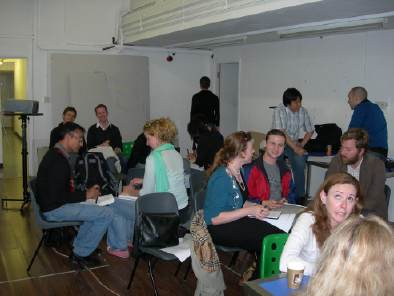
The idea of pairing MA/MBA students to work together is not original. What was surprising was the degree of engagement achieved in a face-to-face encounter that only lasted three hours, stimulated by the students' appetites to work on something tangible and learn from each other - and the potential for unusual and sustainable collaboration that might result.
Of the initial briefs created by MBA students (see previous blog post, MBA elective week 2), two were selected by tutor Noam Toran as suitable for the MA students (the others being 'too narrow a space to design in'): a service for sex workers negotiating with clients, and the redesign of economy air transport. During our afternoon at the Royal College of Art, first we saw presentations by the first year MA Design Products students in response to these briefs, ranging from witty and challenging explorations to fundamental reconceptualisations. Then it was the turn of second year students from Design Products and also the MA Interaction Design (with tutor Nina Pope), who wanted an opportunity to work with an MBA student, some of whom had designed service propositions. Students worked in pairs to discuss projects in detail and examine how to take things further, from a design practice perspective and from a management perspective. Finally, the MBA students agreed with their MA pairs a piece of homework from a relevant management discipline to take the project further.
I asked students to consider what design and management practices bring in different ways to invention and design projects; to what extent design can lead and where management disciplines and research activity serve to complement and extend the work of designers. Next week the MBA students will take their turns to present their work to the combined group.
Tuesday, May 16, 2006
MBA elective week 3: what designers do well (and what they don't do well)
In our third class I used as a teaching case my onging work as lead designer on a digital media project at Rich Mix, a new cultural venture in east London. Rich Mix partially opened at the end of April, without fanfare, seeking to build up audiences and test processes as different elements of the venture open to the public. For now, you can have lunch in the cafe or go see Mission Impossible in the beautiful cinema designed by Ali Zaidi. Other parts of the organization including its bar designed by Usman Haque, the creative workspaces, BBC London's studio, the performance spaces, and the News Room - the part I'm working on - will open between now and the formal opening in November.
For the purposes of the MBA class, I presented students with a number of artefacts created since I was initially approached by Rich Mix when the leadership team started asking what it could offer its diverse audiences in the way of experiences and content delivered using networked digital media edited by guest editors. What began as an open question along the lines of 'Can we do something interesting that will draw people in and help them connect to Rich Mix and to others?' lead to a design-led process where we tried to answer this, despite not having what managers would see as a business case, or value proposition. The class considered different artefacts created during the design/innovation process to date including an early document outlining the concept; notes, sketches and photos from design workshops; and the current development plan.
At the end of the class, students working in pairs took turns to present a way forward for the Rich Mix News Room as currently conceived, one pair presenting as McKinsey-type strategy consultants; another pair as a technology consultancy such as IBM or Accenture; another as the London Mayor's office; another as the BBC; another as an innovation consultancy. Each of the presentations brought home (sometimes in a hilarious manner) the opportunities, and limitations, of operating within a particular paradigm. The design-led process, as currently enacted for the Rich Mix News Room, also has limits but it does offer a way of generating, and exploring ideas, especially given limited resources, that may lead to designing a viable, sustainable solution (in contrast to the management paradigm described Boland and Collopy in 'Managing as Designing', 2004). The question underpinning the elective, and indeed my research, is what the limits of design leadership are.
What the class discussion reinforced was the need for designers to work alongside managers/decision-makers within organizations, not in isolation. But it also suggested that design methods (such as concept modelling, experience prototyping, scenarios and so on) are powerfully able to develop and communicate ideas, without significant investment, in situations with unframed problems.
For the purposes of the MBA class, I presented students with a number of artefacts created since I was initially approached by Rich Mix when the leadership team started asking what it could offer its diverse audiences in the way of experiences and content delivered using networked digital media edited by guest editors. What began as an open question along the lines of 'Can we do something interesting that will draw people in and help them connect to Rich Mix and to others?' lead to a design-led process where we tried to answer this, despite not having what managers would see as a business case, or value proposition. The class considered different artefacts created during the design/innovation process to date including an early document outlining the concept; notes, sketches and photos from design workshops; and the current development plan.
At the end of the class, students working in pairs took turns to present a way forward for the Rich Mix News Room as currently conceived, one pair presenting as McKinsey-type strategy consultants; another pair as a technology consultancy such as IBM or Accenture; another as the London Mayor's office; another as the BBC; another as an innovation consultancy. Each of the presentations brought home (sometimes in a hilarious manner) the opportunities, and limitations, of operating within a particular paradigm. The design-led process, as currently enacted for the Rich Mix News Room, also has limits but it does offer a way of generating, and exploring ideas, especially given limited resources, that may lead to designing a viable, sustainable solution (in contrast to the management paradigm described Boland and Collopy in 'Managing as Designing', 2004). The question underpinning the elective, and indeed my research, is what the limits of design leadership are.
What the class discussion reinforced was the need for designers to work alongside managers/decision-makers within organizations, not in isolation. But it also suggested that design methods (such as concept modelling, experience prototyping, scenarios and so on) are powerfully able to develop and communicate ideas, without significant investment, in situations with unframed problems.
Monday, May 08, 2006
MBA elective week 2: practices, processes and methods
In our second session I introduced the project the students will undertake with MA Design Products students from the RCA. We were then joined by tutor Noam Toran, who described some of the briefs (translation for non-designers: project starting points) given to the platform (translation: teaching context in an MA) he teaches at the RCA, and showed some of the work students made in response. We then asked the MBA students to create a brief for the MA students to design a service. As anticipated, the writing of a brief lead to a set of discussions about how to engage with designers; the purpose(s) of this kind of document in these engagements; and the likely responses from designers.
Students worked in small groups and came up with five briefs which have now been sent to the RCA (where they may be modified to meet the educational goals of the college):
- Financial Liberation (about reinventing the relationship of people with their money: a service for people who do not have much money and are excluded from credit, mortgages and financial institutions)
- Invisible Friend (a service to make you feel like you have a friend, but delivered by a team of people, whom you never meet, delivered through different interfaces or service elements)
- Companion Provider (a service so you can hire a person to do friend-like things with you)
- Service, Disservice (aiming to re-invent existing, often badly designed services such as flying economy or the UK post office)
- Safety for Sex Workers (a service to support sex workers when negotiating with clients)
Several of these are clearly very high level - presenting opportunities for both sets of students to explore to what extent design practice/thinking can contribute to radical or incremental innovation. Only one brief specified that the service should make money; in their language and analysis, several demonstrated a desire to respond to social needs (rather than analysing business opportunities).
The MBA students are keen to see what artefacts the MA students will make in response to these ideas. More soon.
Students worked in small groups and came up with five briefs which have now been sent to the RCA (where they may be modified to meet the educational goals of the college):
- Financial Liberation (about reinventing the relationship of people with their money: a service for people who do not have much money and are excluded from credit, mortgages and financial institutions)
- Invisible Friend (a service to make you feel like you have a friend, but delivered by a team of people, whom you never meet, delivered through different interfaces or service elements)
- Companion Provider (a service so you can hire a person to do friend-like things with you)
- Service, Disservice (aiming to re-invent existing, often badly designed services such as flying economy or the UK post office)
- Safety for Sex Workers (a service to support sex workers when negotiating with clients)
Several of these are clearly very high level - presenting opportunities for both sets of students to explore to what extent design practice/thinking can contribute to radical or incremental innovation. Only one brief specified that the service should make money; in their language and analysis, several demonstrated a desire to respond to social needs (rather than analysing business opportunities).
The MBA students are keen to see what artefacts the MA students will make in response to these ideas. More soon.
Wednesday, April 26, 2006
MBA elective starts today: design leadership v design management
Today's the first class of the elective in Design Leadership that I'm teaching to MBA students at the Saïd Business School (SBS) at Oxford University. This is the first such elective at the school, and one of relatively few round the world. The first wave of 'design management' teaching in business schools in the 1980s-90s such as at London Business School is now giving way to what might be seen as a second wave, with a focus on 'design leadership' and 'design thinking'. Examples are Stanford's d-school, and the new school of management and design at Zollverein in Germany. These programmes are building on earlier work by designers, design managers and academics which established the need for a better understanding of the interfaces between design and organisations.
Our eight-week course at the Saïd, which 19 MBAs have signed up for, aims to equip students with an understanding of the processes, methods and practices within design disciplines; expose them to the influential theories, models, frameworks of analysis for managing design activity; help them develop a vocabulary with which to communicate ideas about design and design management both with designers and with others; and enable them to develop relevant skills to use within management contexts. Part of the activity includes a joint project with MA Design Products students from the Royal College of Art, London, working with designer and tutor Noam Toran. The design of the elective draws on my experience of leading design teams including multidisciplinary groups grappling with complex problems in which no single discipline has all the answers.
The pre-class task I set the class proved very powerful. I asked the students to take photos and screenshots of two examples of good design, and two examples of bad design, at the SBS - a shared context in which the architecture, interior design, service and process design, intranet and IT services provided a rich environment for students to consider and critique. As the students presented their examples one by one, definitions of 'good' and 'bad' design emerged, which led on to a structured discussion about how designs (outcomes) are designed (process), and to what extent organizational structures and roles are equipped to facilitate good design - or to lead by design. In the second half of the class, we watched the ABC television documentary in which IDEO designers re-design the shopping trolley in five days. Extracting from this a set of design practices, the students then worked in pairs to use this process to say how they would go about re-designing some of the artefacts in the school they found were badly designed. These hands-on exercises helped students reflect on the material reality of design decisions and begin to understand the organizational issues involved in managing design practices - whether done by designers or others.
Our eight-week course at the Saïd, which 19 MBAs have signed up for, aims to equip students with an understanding of the processes, methods and practices within design disciplines; expose them to the influential theories, models, frameworks of analysis for managing design activity; help them develop a vocabulary with which to communicate ideas about design and design management both with designers and with others; and enable them to develop relevant skills to use within management contexts. Part of the activity includes a joint project with MA Design Products students from the Royal College of Art, London, working with designer and tutor Noam Toran. The design of the elective draws on my experience of leading design teams including multidisciplinary groups grappling with complex problems in which no single discipline has all the answers.
The pre-class task I set the class proved very powerful. I asked the students to take photos and screenshots of two examples of good design, and two examples of bad design, at the SBS - a shared context in which the architecture, interior design, service and process design, intranet and IT services provided a rich environment for students to consider and critique. As the students presented their examples one by one, definitions of 'good' and 'bad' design emerged, which led on to a structured discussion about how designs (outcomes) are designed (process), and to what extent organizational structures and roles are equipped to facilitate good design - or to lead by design. In the second half of the class, we watched the ABC television documentary in which IDEO designers re-design the shopping trolley in five days. Extracting from this a set of design practices, the students then worked in pairs to use this process to say how they would go about re-designing some of the artefacts in the school they found were badly designed. These hands-on exercises helped students reflect on the material reality of design decisions and begin to understand the organizational issues involved in managing design practices - whether done by designers or others.
Saturday, April 01, 2006
'Meeting the Challenges of Design Leadership' conference, Amsterdam
For the details of the conference, see the Design Management Institute's website (link below), and see also Ralf Beuker's blog on his workshop there and the issues raised at www.design-management.de.
As is typical at conferences involving both practitioners and academics, the conversations were taking place at several levels. Some people were telling stories about their practices; others were refering to or defining models and building directly on an evolving and transferable body of knowledge. As a relative newcomer to this conversation with a practitioner background, I was glad to have an opportunity to hear different positions articulated and to meet some interesting, thoughtful people. As I understood it, the conference was trying to mark out different models of design leadership and their implications, within the terms of reference of the organizing body, the DMI, whose vision is to "improve organizations worldwide through the effective management of design for economic growth".
Leaving aside for the moment the ends to which design management, or indeed design leadership, might be put, I'd like to repeat some the key issues I heard raised at the event:
- The desire of designers to be taken more seriously/have their value understood/have a seat on the board; or the claim that this is already so (design as function; the strategic role of design).
- The question of how to export to other domains designers' approaches, practices, methods and tools (often characterized as 'design thinking' - potentially a kind of design leadership).
- The question of whether designers want to own 'creativity' within organizations. If managers and entrepreneurs work in reflexive, iterative, conceptual, creative ways, and make use of design thinking where relevant, does this need to be labelled 'design leadership' or could it just be 'leadership'?
- The problems created by the language of some designers, and by much of design education, which serves to keep non-designers out.
- The argument that people involved in design management (practitioners in design and client organizaions, and academics researching and teaching in this area) are mostly talking to themselves; that management and change management consultants, for example, are already adopting some of the practices of designers (but not calling it design) and may step up to the challenge of further disseminating them before designers and design educators do.
What was missing for me was the following
- Acknowledgement of emerging areas of design within organizational contexts in particular service design, interaction design and experience design. The services sector now accounts for 70% of many advanced industrial economies (UNCTAD, 2004, World Investment Report: The Shift Towards Services). But the conference emphasis was on branding, communications and product design which are, more or less, solved problems and certainly well-framed problems.
- Greater acknowledgement of non-corporate contexts for design including the public sector and the growing area of social entrepreneurship, covered for example through a detailed case study presentation, rather than mentioned only within the context of one academic paper. See for example the research work of the UK Design Council's RED unit, and the Skoll Centre for Social Entrepreneurship, part of the institution where I work.
- A deeper discussion about the limits to design leadership. Could design leadership create an effective response to a disaster or emergency? Could it lead to a coherent policy within Europe on handling asylum seekers? Could design leadership, rather than other kinds of leadership, lead to sustainable innovation in the involvement of citizens in democratic processes?
Clearly some of these issues challenge the DMI's vision of using design management to improve economic growth but a case could be made for their inclusion, or at least their consideration, within this framework.
As is typical at conferences involving both practitioners and academics, the conversations were taking place at several levels. Some people were telling stories about their practices; others were refering to or defining models and building directly on an evolving and transferable body of knowledge. As a relative newcomer to this conversation with a practitioner background, I was glad to have an opportunity to hear different positions articulated and to meet some interesting, thoughtful people. As I understood it, the conference was trying to mark out different models of design leadership and their implications, within the terms of reference of the organizing body, the DMI, whose vision is to "improve organizations worldwide through the effective management of design for economic growth".
Leaving aside for the moment the ends to which design management, or indeed design leadership, might be put, I'd like to repeat some the key issues I heard raised at the event:
- The desire of designers to be taken more seriously/have their value understood/have a seat on the board; or the claim that this is already so (design as function; the strategic role of design).
- The question of how to export to other domains designers' approaches, practices, methods and tools (often characterized as 'design thinking' - potentially a kind of design leadership).
- The question of whether designers want to own 'creativity' within organizations. If managers and entrepreneurs work in reflexive, iterative, conceptual, creative ways, and make use of design thinking where relevant, does this need to be labelled 'design leadership' or could it just be 'leadership'?
- The problems created by the language of some designers, and by much of design education, which serves to keep non-designers out.
- The argument that people involved in design management (practitioners in design and client organizaions, and academics researching and teaching in this area) are mostly talking to themselves; that management and change management consultants, for example, are already adopting some of the practices of designers (but not calling it design) and may step up to the challenge of further disseminating them before designers and design educators do.
What was missing for me was the following
- Acknowledgement of emerging areas of design within organizational contexts in particular service design, interaction design and experience design. The services sector now accounts for 70% of many advanced industrial economies (UNCTAD, 2004, World Investment Report: The Shift Towards Services). But the conference emphasis was on branding, communications and product design which are, more or less, solved problems and certainly well-framed problems.
- Greater acknowledgement of non-corporate contexts for design including the public sector and the growing area of social entrepreneurship, covered for example through a detailed case study presentation, rather than mentioned only within the context of one academic paper. See for example the research work of the UK Design Council's RED unit, and the Skoll Centre for Social Entrepreneurship, part of the institution where I work.
- A deeper discussion about the limits to design leadership. Could design leadership create an effective response to a disaster or emergency? Could it lead to a coherent policy within Europe on handling asylum seekers? Could design leadership, rather than other kinds of leadership, lead to sustainable innovation in the involvement of citizens in democratic processes?
Clearly some of these issues challenge the DMI's vision of using design management to improve economic growth but a case could be made for their inclusion, or at least their consideration, within this framework.
Day to Day Data - two weeks later
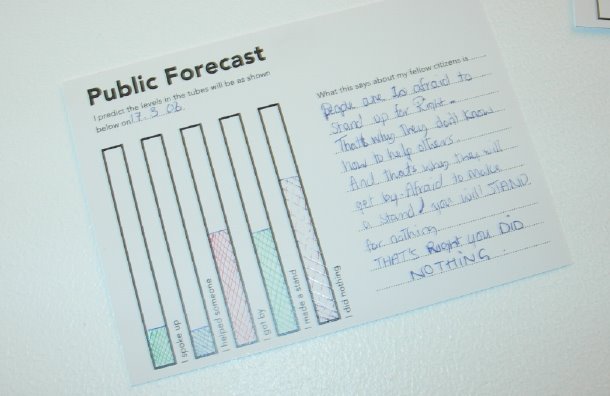
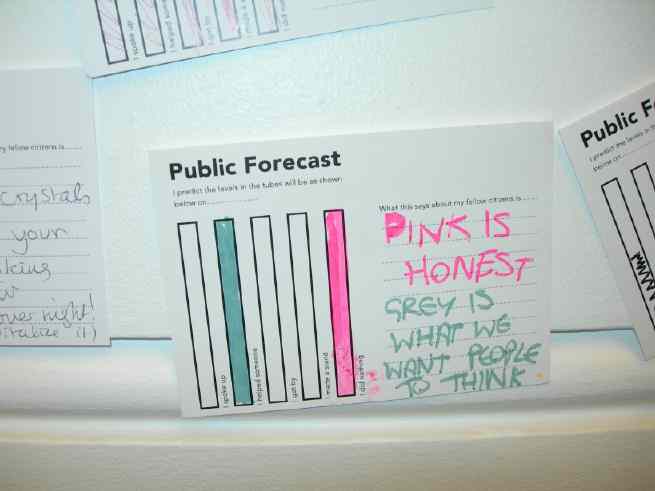
The badges in the five tubes in the public library were all gone within two weeks: that's approximately 7,500 badges distributed unevenly and anonymously on coats, jackets, bags, and the pavements of Kennington, south London. The library staff said that lots of children had taken them and seemed apologetic about this: in their view, they weren't taking the project seriously. But a man in the library, overhearing this conversation, mentioned that all the children at his kids' school were wearing the badges and that they had raised discussion there.
On the wall opposite the now empty tubes I saw some filled in 'public forecast' cards I designed, asking people to predict the levels of badges in the tubes on a particular date, with comments. The two shown here suggest a disappointment about people's engagement with the social. "Pink is honest, grey is what we want people think," writes one person. The pink badges say "I did nothing" while the grey ones say "I helped someone". The other card says "People are to (sic) afraid to stand up for Right."
I don't yet have pictures of the levels of the tubes changing day by day as people took the badges. The curator Ellie Harrison has arranged for another set of badges to be installed, and asked for a daily photo documenting the changing levels.
Reviews: The exhibition is featured in the April 2006 issue of Art Monthly and is also mentioned on the Information Aesthetics website.
Thursday, March 23, 2006
Physical Bar Charts in Day to Day Data
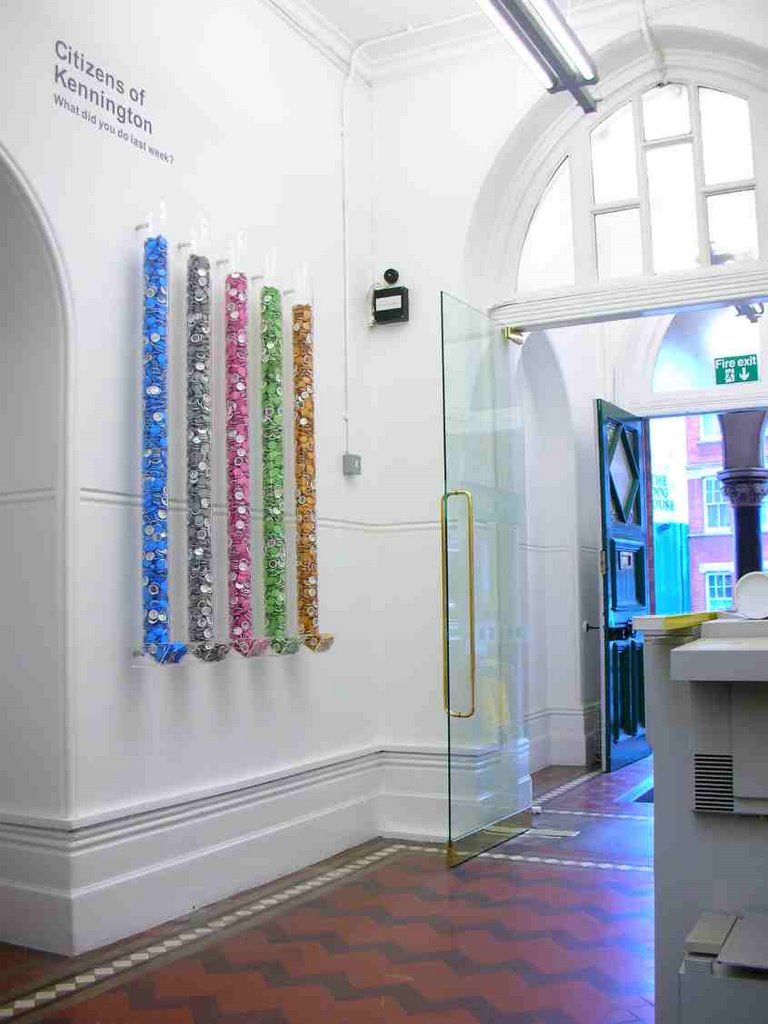
My project 'Physical Bar Charts' is currently installed in the Durning Library, a busy public library in south London, part of the group exhibition Day to Day Data, which opened on 10 March. It consists of five acrylic tubes mounted on the wall, each with a dispenser at the bottom. Each tube is filled initially with around 1500 button badges, of one colour, with a single printed message on. Over the course of the exhibition people can help themselves, the levels in the tubes drop and the reverse bar chart shows the varying levels of engagement of its passers-by.
Here's a picture before the general public was allowed to help themselves.
Pink "I did nothing"
Grey "I helped someone"
Green "I spoke up"
Blue "I made a stand"
Orange "I got by"
Designing at Rich Mix
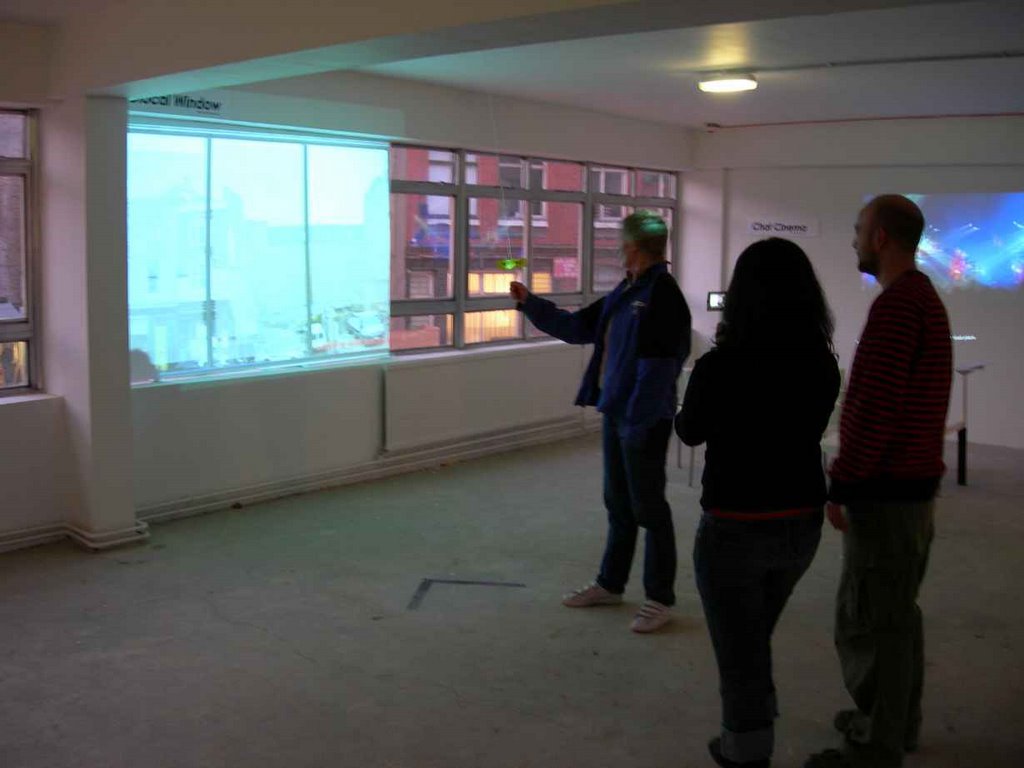
Since late in 2005 I've been working with arts producer Greg Hilty to develop a strategy for a new public space within a new venue and cultural organization called Rich Mix, located on Bethnal Green Road in London's East End http://www.richmix.org.uk. The approach we have been taking is to use design to frame the questions, and, we hope, eventually get to the answers, as to what the particular space we are working on is for.
The building, when it opens (in stages from April) will have three cinemas, a performance space, cafe, bar, a media lab, workspaces, a visual art gallery...and a space, currently called 'the News Room' which is currently undefined. Developing that definition is part of our brief, which is an amazing opportunity and significant challenge. Unlike the designers of the cinema or bar and so on, we have an additional challenge of invention. Our design-led approach has been enacted through a series of concept development workshops with a range of people, plus other typical design techniques such as sketching and modelling. People involved in this development process include Rich Mix staff, invited designers and community activists, and George Grinsted (web developer) http://www.imgeorge.org and Radarstation http://www.radarstation.co.uk), interaction designers who created the experience prototypes we tested with an invited audience on February 24. With the agreement of Keith Khan (Rich Mix CEO) and Nick Kilby (COO), our next step is to further iterate the concepts we have developed for another round of experience prototyping. My current working definition for the Rich Mix News Room is that it is a 4-dimensional blog (2-d screens and opportunities for interaction, made present in a physical space, changing over time).
Subscribe to:
Posts (Atom)


